

How to Mix Interior Design Styles: A 2026 Guide
Table of Contents
- Why Mixing Interior Design Styles Works in 2026
- Choose a Primary Style and a Secondary Style
- Interior Design Color Palette Rules for Blended Rooms
- Mixing Modern and Vintage Decor Without a Clash
- The 80/20 Rule and Repetition for Visual Balance
- Budget-Friendly and Small Space Mixing Strategies
- Finding the Best Online Home Decor Shops for Mixed Styles
- Conclusion
- Frequently Asked Questions
Last Updated: September 17, 2026
Why Mixing Interior Design Styles Works in 2026
Learning how to mix interior design styles is the fastest way to make a first apartment look collected instead of catalog-ordered. The 1stDibs Guide to 2026 Designer Trends found that eclecticism and organic modernism were the second- and third-most-cited styles among surveyed designers, which tells you the pros have stopped treating "one style per room" as a rule.
Choose a Primary Style and a Secondary Style
Pick one style to lead at about 70% of the room, then let a second style play a supporting role at roughly 30%. This is the foundation of how to mix interior design styles without the result looking random.
Start by naming your two styles out loud:
- Primary style: the look you want people to notice first
- Secondary style: the accent that adds personality
- Anchor style: the one your big furniture already follows
Interior Design Color Palette Rules for Blended Rooms
The interior design color palette rules for a mixed room are simple: choose one neutral base, one mid-tone, and one accent, then repeat them across both styles. Color is the glue that makes two eras look related.
The 60-30-10 Split for Mixed Aesthetics
The 60-30-10 split keeps a blended room from turning into visual noise. Use 60% of your color in a dominant neutral, 30% in a secondary tone, and 10% in an accent.
| Share | Role | Example in a Mixed Room |
|---|---|---|
| 60% | Dominant neutral | Warm white walls, oatmeal sofa |
| 30% | Secondary tone | Wood tones, gray rug, linen curtains |
| 10% | Accent | Black metal, brass, deep green |
Mixing Modern and Vintage Decor Without a Clash
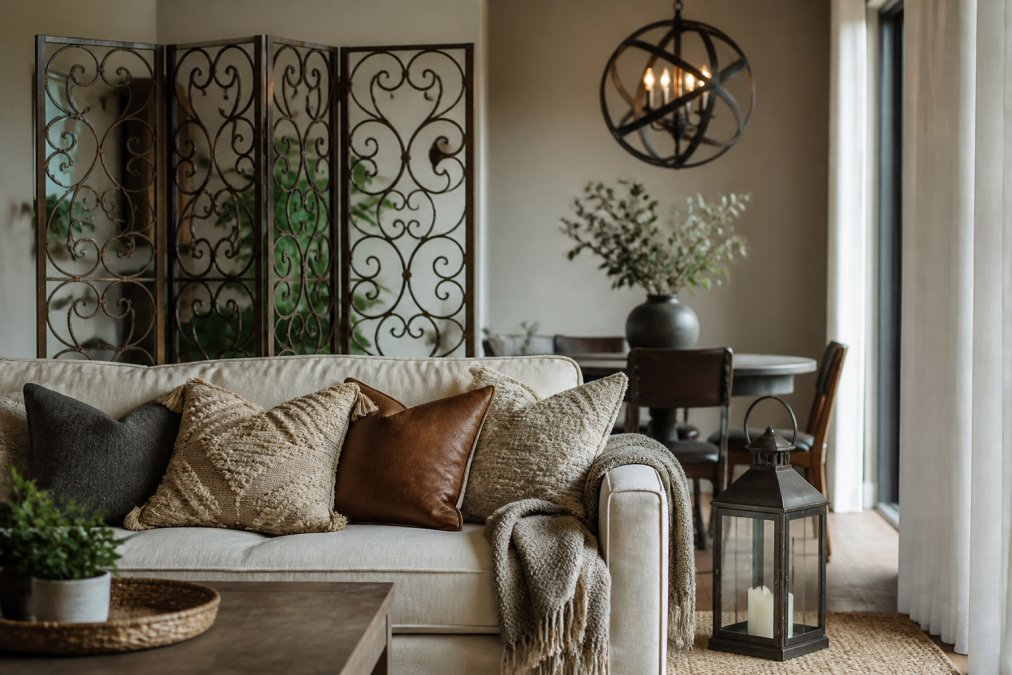
Mixing modern and vintage decor works when both eras share a color, a shape, or a material. Find that shared thread first, then let everything else differ. But the reason most mixed rooms fail isn't a lack of shared color, it's that the two styles are fighting over the same design job.
Why Styles Fight: The Three Axes of Clash
Design theory treats a style as a bundle of decisions along three axes. Two styles clash when they disagree on all three at once, and they complement when they agree on at least one.
- Visual weight. How heavy or light a piece reads. A chunky reclaimed-wood coffee table is heavy; a glass-and-chrome side table is light. Two heavy statement pieces in one sightline compete; one heavy plus one light reads as balance.
- Line and geometry. Straight, angular, and geometric versus curved, organic, and irregular. A boxy mid-century sofa and a tufted Victorian settee are both upholstered, but their lines disagree, so they fight unless something else ties them.
- Ornament level. How much surface detail a piece carries. A plain linen shade is low-ornament; a carved, gilded frame is high-ornament. Pairing two high-ornament pieces in one corner creates visual noise; pairing high with low lets each read clearly.
The Shared-Thread Test
Before you buy, run each candidate piece through this test against the room's existing anchor:
- Name one axis where the new piece agrees with the anchor (weight, line, or ornament).
- Name one axis where it deliberately disagrees.
- If it disagrees on all three, it's a clash, not a mix, put it back.
Anchor Pieces That Tie Both Eras Together
Anchor pieces are the large items both styles can agree on. Choose one or two, and let the smaller decor do the arguing.
The 80/20 Rule and Repetition for Visual Balance
Visual balance in a mixed room comes from repetition, not symmetry. Repeat a color, a finish, or a shape at least three times, and the eye reads the room as unified.
- Repeat your accent color in three places: a frame, a pillow, a lamp base
- Repeat one material, such as black metal or natural wood, across both eras
- Repeat one shape, like a sphere or an arch, in small doses
Budget-Friendly and Small Space Mixing Strategies
Budget-friendly mixing starts with one splurge anchor and a set of cheap supporting pieces. In a small apartment, the same logic keeps the room from feeling crowded, but the mechanics change, because you have less floor area to absorb a mistake and less wall to hide one.
The One-Anchor Budget Split
Most guides assume a full room overhaul. You don't need one. A workable split for a renter or first-time buyer:
Vintage Wrought Iron 3-piece room →
- 50-60% of the decor budget on one anchor piece you'll keep for years, lighting, a rug, or a statement chair.
- 30% on mid-size supporting pieces that carry the secondary style, a side table, a floor lamp, a mirror.
- 10-20% on small accents that repeat your accent color, frames, pillows, a tray, a lantern.
Mixing Styles Using What You Already Own
The cheapest move is to re-style existing furniture instead of replacing it. Three low-cost updates that shift a piece toward your secondary style without a purchase:
- Swap the hardware. New knobs or pulls on a dresser or cabinet change its era read for a few dollars.
- Swap the shade or the legs. A plain drum shade reads modern; a tapered fabric shade reads traditional. Tapered wood legs read mid-century; straight black metal legs read industrial.
- Reframe, don't replace. A new frame around existing art changes its style signal more than the art itself.
Small-Space Rules That Actually Hold Up
For studios and small rooms, three rules do most of the work:
- Keep the palette to three colors so the room reads as one space rather than several zones.
- Use one anchor per zone, not per wall. A studio typically has two or three zones (sleep, sit, work). One anchor each is enough; more than that and the eye has nowhere to rest.
- Choose multi-use pieces. A room divider that also hides a workspace, an ottoman that also stores, a bench that also holds books.
Scale Math for Small Rooms
Scale is where small-space mixes break. Two rules of thumb worth writing down before you buy:

- Rug: leave roughly 18-24 inches of bare floor between the rug edge and the walls in a small room; a rug that nearly touches the walls shrinks the room.
- Sofa and coffee table: leave about 14-18 inches between the sofa front and the coffee table so the walkway stays clear.
Style Auditing Checklist for Your First Apartment
Run this audit before you buy anything. It takes about 20 minutes and saves you from a mismatched cart.
- List every large furniture piece you already own
- Name the style each piece leans toward
- Identify your primary style by majority
- Pick one secondary style for accents
- Choose a 60-30-10 palette and write down the three colors
- Find one anchor piece both styles can share
- Mark three spots where your accent color will repeat
- Set a budget split: most on the anchor, less on accents
- Measure the room, the walkways, and the doorway before ordering
Finding the Best Online Home Decor Shops for Mixed Styles
The best online home decor shops for mixed styles are the ones that let you see materials, sizes, and finishes clearly before you buy. Blending eras depends on details, and a listing photo that hides scale will wreck your plan.
A few things to check on any product page:
- Material and finish, stated plainly
- Exact dimensions in inches or centimeters
- Whether the item ships or needs pickup
- Return policy, in case the scale is off
Conclusion
The hard part of mixing styles isn't finding pieces. It's committing to one primary style and repeating it with discipline. Most mismatched rooms fail because the shopper bought two of everything and anchored nothing.
Frequently Asked Questions
Is it okay to mix interior design styles in one room?
Yes. Blending styles is one of the most popular approaches in 2026, with eclecticism and organic modernism ranking as the second and third most-cited styles among surveyed designers, according to the 1stDibs Guide to 2026 Designer Trends. The trick is to pick one dominant style and let a second style play a supporting role, then repeat a few colors, materials, or shapes across the room so the mix reads as intentional rather than accidental.
What is the 80/20 rule when mixing modern and vintage decor?
The 80/20 rule means roughly 80% of a room follows one main style and 20% comes from a contrasting style. For example, keep most furniture and the wall color modern and neutral, then add vintage accents like a wrought iron room divider or an antique-inspired lantern. This ratio keeps the space cohesive while still giving the vintage pieces room to stand out as focal points.
How do you choose a color palette when blending two styles?
Start with one neutral base that covers walls and large furniture, then add two accent colors pulled from pieces you already own. A common approach is the 60-30-10 split: 60% neutral shades, 30% a secondary tone, and 10% a bold accent. This structure lets traditional and contemporary pieces share a room without fighting each other, because the color scheme does the unifying work.
Where should I shop for home decor when I want to mix styles?
Look for shops that carry a curated range of eras rather than a single aesthetic, so you can source both modern and vintage-inspired pieces in one order. Downtown5, for example, stocks items like a 5-light black iron sphere chandelier at $138.87 and large decorative lanterns at $21.00, which work as bridging accents in a mixed-style room. Check shipping terms and return policies before ordering large pieces.