

How to Create a Cozy Reading Nook in a Small Apartment
Table of Contents
- Step 1: Choose the Right Spot for Your Cozy Reading Nook
- Step 2: Pick Space-Saving Furniture for Apartments
- Step 3: Find the Best Lighting for Reading Nooks
- Step 4: Layer Textiles, Throw Pillows, and Knit Blankets
- Step 5: Add Vertical Storage and Book Storage
- Step 6: Try Easy DIY Reading Nook Projects
- Step 7: Solve Ergonomics, Soundproofing, and Textile Care
- Frequently Asked Questions
Last Updated: September 25, 2026
Step 1: Choose the Right Spot for Your Cozy Reading Nook
A functional cozy reading nook can fit in as little as 4 square feet, according to design guidance shared by Instagram creator @reel/DUsvqfRicXn. That is roughly the footprint of a single armchair. The trick is knowing where to steal that space.
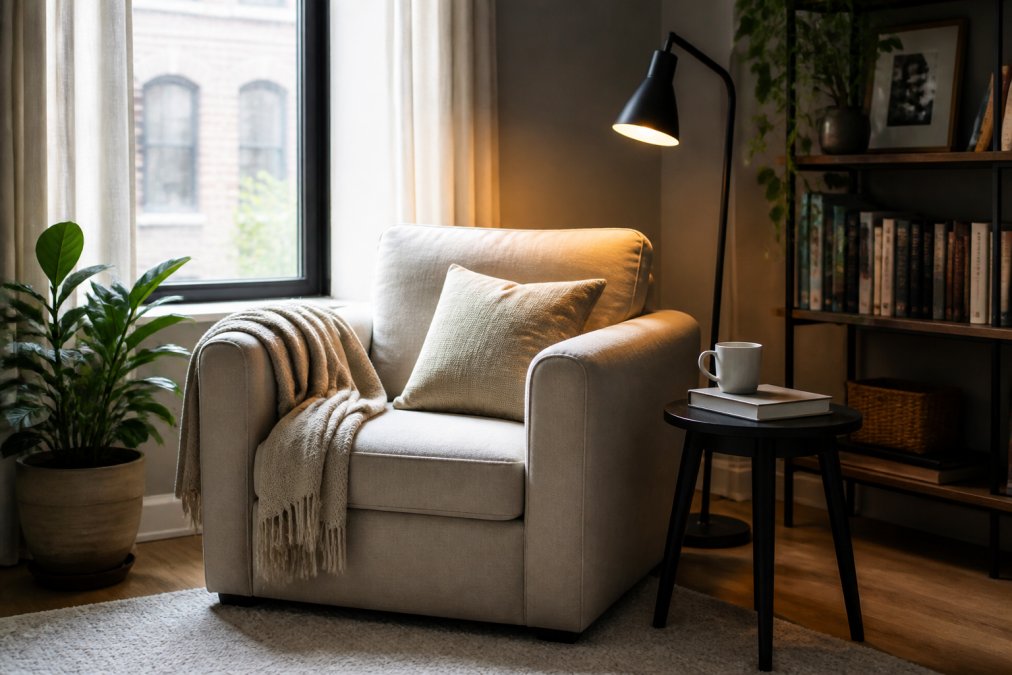
Corner Use and Window Seats
Corners are the most underused real estate in a small apartment. An empty corner beside a bookshelf or between two windows can hold a reading chair and a slim side table without blocking traffic.
Steal Space From Any Room
Look for dead zones first:
- The strip beside a bed
- The gap between a sofa and a wall
- The area under a slanted ceiling
- A hallway wide enough for one chair
Measure before you commit. A reading chair needs about 3 feet of clearance to sit down comfortably.
Step 2: Pick Space-Saving Furniture for Apartments
Space-saving furniture for apartments starts with one rule: every piece should do two jobs. An ottoman with hidden storage beats a plain footstool. A narrow console that holds books beats a decorative table. But the rule only pays off if the piece actually fits, and most apartment nooks fail on dimensions, not style.
Start With the Chair Footprint
A standard armchair runs about 30 to 36 inches wide and 32 to 38 inches deep. A chaise or oversized lounge chair can push past 40 inches deep, which is why it swallows small rooms. Before you buy, tape the footprint on the floor with painter's tape and walk the path you would take to sit down. If you cannot step into the taped square and turn around, the chair is too big.
Multi-Functional Pieces That Earn Their Floor Space
These are the categories that consistently work in small apartments:
- Storage ottomans. A 20-inch cube with a lift-off lid holds roughly 15 to 20 paperback books or a full season of throw blankets. It doubles as a footrest and a guest seat.
- Narrow console or sofa-back table. A 10- to 12-inch-deep table behind a sofa or beside a chair holds a lamp, a mug, and a stack of books without eating walking space.
- Ladder shelves. A leaning ladder shelf uses vertical wall space and needs no drilling. Look for one with a 12-inch base depth so it does not tip forward when loaded.
- Wall-mounted drop-leaf desks. A drop-leaf desk folds flat to about 4 inches deep and opens to a 24-inch work surface, useful if the nook doubles as a work-from-home spot.
- Daybeds and trundle frames. A twin daybed with a trundle gives you a reading sofa by day and sleeping space for a guest by night. This is the single biggest space win if the nook is in a studio or guest room.
The Trade-Off Nobody Mentions
Multi-functional furniture is heavier and often less comfortable than a dedicated piece. A storage ottoman with a firm lid is not as soft underfoot as a plush footstool. A daybed with a trundle frame sits higher than a sofa, which can make reading posture awkward. Pick the function you will use daily, reading, and treat the second function as a bonus, not the reason to buy.
Budget Reality Check
You do not need to spend a lot. A storage ottoman, a ladder shelf, and a plug-in wall sconce together can be assembled for well under the cost of one designer lounge chair, and they solve three problems, seating, storage, and light, at once. Buy the chair last, after you know the exact footprint the corner can spare.
Step 3: Find the Best Lighting for Reading Nooks
The best lighting for reading nooks combines two layers: a bright task light aimed at your page and a soft ambient glow for the rest of the room. One light source alone will leave you squinting or straining.
Task Lighting vs. Ambient Lighting
Task lighting is the focused beam you read by. Ambient lighting sets the mood. You need both.
Step 4: Layer Textiles, Throw Pillows, and Knit Blankets
Texture is what turns a chair in a corner into a cozy reading nook. Designers recommend draping a warm-tone throw and adding at least one textured cushion to define the space, per Instagram design guidance.
Build your layers in this order:
- A knit blanket over the chair back
- Two throw pillows in different textures
- A small rug underfoot to mark the zone
- A wall hanging or tapestry if the wall feels bare
Step 5: Add Vertical Storage and Book Storage
Floor space is precious, so build up. Vertical storage keeps your book storage off the ground and turns a blank wall into part of the nook.
Options that work in small rooms:
- Floating shelves above the chair
- A tall, narrow bookcase in the corner
- A ladder shelf that leans against the wall
- Baskets hung from wall hooks
Step 6: Try Easy DIY Reading Nook Projects
DIY reading nook projects do not need power tools. Most of the best ones take an afternoon.
Try these:
- Hang three floating shelves in a staggered pattern.
- Mount a plug-in wall sconce instead of hiring an electrician.
- Drape a tapestry to hide an ugly wall and soften sound.
- Convert a storage ottoman into a book bin with a fabric liner.
- Paint one accent wall in a warm, dark tone to make the corner feel intentional.
Step 7: Solve Ergonomics, Soundproofing, and Textile Care
Three problems sink most small-space nooks: bad posture, noise, and dirty textiles. Most guides stop at aesthetics and never address them. Fix all three before you call the project done.
Ergonomics: Reading Posture in a Small Chair
A cozy nook that hurts your back is not cozy. The mechanics are simple: your feet should rest flat on the floor or a footstool, your knees should sit at or slightly below hip level, and the book should be held at roughly chest height so your neck stays neutral instead of tipping down.
Soundproofing: Quiet in a Shared Building
Apartments carry noise through shared walls, floors, and ceilings. You cannot rebuild the walls, but you can absorb sound inside the nook. Soft surfaces absorb mid- and high-frequency noise, the kind that comes from televisions, conversation, and hallway traffic.
The highest-impact moves, roughly in order of cost:
- A thick area rug with a pad. A rug plus a felt or rubber pad under it absorbs footfall noise and reduces echo in the room. A 5-by-8 rug is usually the smallest size that meaningfully covers a nook zone.
- Heavy curtains. Lined or double-layer curtains hung floor-to-ceiling absorb sound at the window, which is often the thinnest part of the wall assembly.
- A wall tapestry or textile hanging. A woven tapestry or quilt hung on the shared wall adds mass and absorption. This is the cheapest way to treat a wall you cannot modify.
- A bookshelf packed with books. A full bookcase is a surprisingly effective sound diffuser. Irregular surfaces scatter sound instead of reflecting it.
- A white noise machine or small fountain. Masking does not absorb sound, but it makes the remaining noise less noticeable. A fan on low works too.
Textile Care: Keeping a Fabric-Heavy Nook Clean
A nook layered with a knit blanket, two throw pillows, a rug, and curtains collects dust, pet hair, and crumbs faster than any other corner in a small apartment. Small rooms concentrate the problem because there is less air volume to dilute it.
A workable weekly routine:
- Shake blankets and pillows outside or over a bathtub. This removes loose dust and pet hair before it settles back into the fabric.
- Vacuum on low with a brush attachment. High suction pulls knit fibers and can pill a chunky blanket. Use the upholstery tool on the chair and the brush on the rug.
- Rotate and flip cushions. Foam compresses where you sit most; flipping monthly extends the life of the pillow and the chair.
- Follow the care tag. Most synthetic knits and polyester blends wash cold and air dry. Wool and chunky cotton knits usually need hand washing or dry cleaning, check before you toss them in the machine.
- Spot-clean the rug. Blot, do not rub. Rubbing spreads the stain and fuzzes the pile.
A cozy reading nook is a system, not a chair. Light, texture, storage, sound control, and posture all have to work together before the corner feels finished, and the practical fixes are usually cheaper than the decorative ones.
Frequently Asked Questions
How do I create a cozy reading nook in a small apartment without much floor space?
You only need about 4 square feet to build a functional cozy reading nook. Steal a corner near a window, add a compact reading chair or ottoman, and layer in a warm-tone throw and one textured cushion. A floor lamp with an adjustable shade, like the 158cm linen shade model from Downtown5, gives you task lighting without taking up table space. Keep book storage vertical with a slim shelf or wall-mounted ledge so the floor stays clear.
What is the best lighting for reading nooks in a small apartment?
The best lighting for reading nooks combines task lighting for the page and ambient lighting for atmosphere. A floor lamp with an adjustable shade directs light exactly where you need it, while fairy lights or a small mood lamp soften the rest of the corner. Downtown5's floor lamp includes a brightness-adjustable bulb and remote control, so you can switch from reading brightness to a dim glow without getting up. Avoid relying on a single overhead fixture, which flattens the space.
What space-saving furniture for apartments works best in a reading nook?
Look for pieces that do two jobs. An ottoman with hidden storage holds blankets and doubles as a footrest. A narrow console or wall-mounted shelf keeps books off the floor. If you have room for only one seat, choose an oversized chair with a small footprint rather than a loveseat. Multi-functional furniture lets a 4-square-foot corner serve as seating, storage, and display without crowding the rest of the apartment.
What are common mistakes in book nook design?
The biggest mistake is assuming you need built-in architecture or a window seat. Designers note that space can be stolen from any corner, so a niche is not mandatory. Other common errors include using only overhead lighting, skipping textiles so the corner feels cold, and buying a chair that is too large for the footprint. Measure your corner first, then choose a reading chair, floor lamp, and side table that fit with room to move.
A corner that echoes, strains your neck, and buries you in clutter will never feel cozy, no matter how many pillows you stack there. Downtown5 carries the pieces that solve those problems: a linen-shade floor lamp with an adjustable head for proper task lighting, a portable mood lamp for soft ambient glow, and decorative lanterns for a warm finishing touch. Get started with Downtown5 and turn that empty corner into the best seat in your apartment.