

How to Style Open Shelving in Small Rooms
Table of Contents
- Small Room Shelving Ideas That Actually Work
- Open Shelf Styling Rules That Keep a Small Room Calm
- What to Put on Open Shelves (and What to Leave Off)
- Open Shelving Storage Ideas for Kitchens, Bathrooms, and Living Rooms
- Shelf Depth, Spacing, and Load Limits for Small Spaces
- How to Style Open Shelving in Small Rooms Without Clutter
- Frequently Asked Questions
Last Updated: October 14, 2026
Small Room Shelving Ideas That Actually Work
Open shelving in a small room is a display decision as much as a storage one.
Here's the tension most guides skip: open shelves hold less than cabinets, so they only work when you treat them as a curated display, not a catch-all.
Below, we'll show you exactly how to style open shelving in small rooms, from where to mount the first bracket to what stays off the shelf entirely.
Placement: Where Shelves Belong in a Compact Room
Place open shelves on a solid wall away from door swings and high-traffic paths. In a small room, the goal is to draw the eye upward and outward, not to fill every gap.
Three spots tend to work best:
- Above a low anchor piece. A sofa, desk, or counter gives the shelves a base.
- On the longest uninterrupted wall. Fewer breaks mean cleaner sightlines.
- Beside a window, not across it. You keep the light and add depth.
Skip the wall directly behind a door. You'll bang into it, and the display becomes a dumping ground.
Open Shelf Styling Rules That Keep a Small Room Calm
Three rules do most of the work: limit what's visible, leave negative space, and repeat shapes or colors. Open shelf styling rules for small rooms come down to restraint, not decoration.
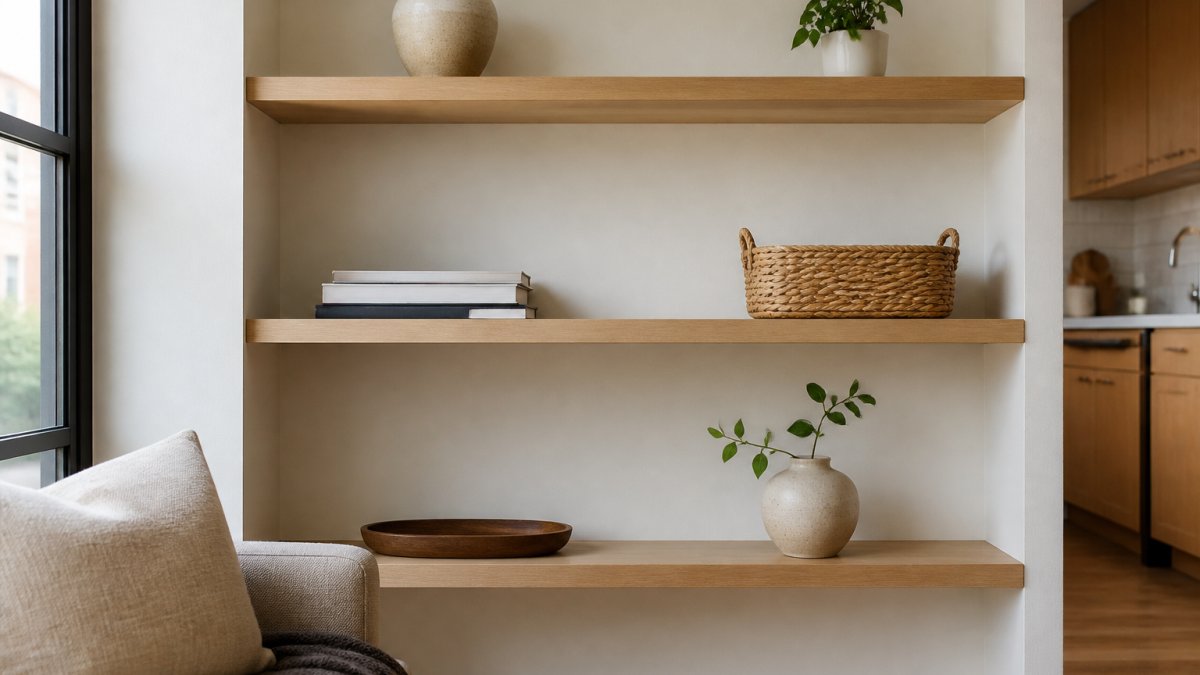
Start with the visual limit. Most people overload shelves because they style item by item instead of looking at the whole wall. Step back after every three objects you add.
The 60-30-10 Visual Limit for Shelf Displays
Treat each shelf like a color palette: roughly 60% of the visible surface stays empty, 30% holds functional items, and 10% is the decorative accent. That ratio keeps a small room feeling open rather than packed.
In practice, a 24-inch shelf might hold three or four objects total. That's it. The empty space isn't wasted, it's the design.
What to Put on Open Shelves (and What to Leave Off)
Put items you use weekly on open shelves, and store everything else behind a door. The best candidates are things that look good and earn their spot.
Good picks:
- Everyday dishes and glassware you actually reach for
- A handmade ceramic vase or two, empty or with a single stem
- Stacked books, laid flat or upright
- A handwoven basket for keys, mail, or remotes
- Small plants or dried branches
Leave off:

- Paperwork, chargers, and loose cables
- Anything you'd hide if a guest walked in
- Matching sets of everything, which reads as flat
Open Shelving Storage Ideas for Kitchens, Bathrooms, and Living Rooms
Open shelving storage ideas work room by room, and each room asks for a different mix of function and display. The kitchen wants durability, the bathroom wants moisture-friendly materials, and the living room wants personality.
A useful rule before you mount anything: match the shelf material to the room's worst day, not its best one. Steam, grease, splashes, and direct sun all shorten the life of a display, and a small room has no spare wall to move it to.
Small Kitchen Shelving: Dishes, Glassware, and Everyday Items
In a small kitchen, stack plates in short piles of four to six and line glasses in a single row. Colored glass adds interest without extra objects. Keep the items you use daily at arm's height and the pretty-but-rare pieces higher up.
A compact room benefits from one material repeated across the shelf. Ceramic, glass, and wood together read as a theme. Five materials read as a mess.
Two kitchen-specific trade-offs worth planning for:
- Grease and steam. Shelves within a few feet of the range collect a tacky film. Keep the closest shelf for items you wash often, or move the display to the wall opposite the cooking zone.
- Depth versus reach. An 8-inch shelf holds a dinner plate; a 6-inch shelf does not. If the wall is narrow, plan on salad plates, mugs, and glasses rather than full-size dinnerware.
Bathroom Shelving: Moisture, Small Bottles, and Towels
Bathrooms punish open storage more than any other room. Steam and splashes leave water spots on glass and can warp unfinished wood, so choose sealed or painted finishes and wipe shelves weekly.
What works on a small bathroom shelf:
- Rolled hand towels in a single row, two or three deep
- Decanted soap, lotion, or bath salts in matching containers
- A small tray to corral cotton pads and swabs
- One plant that tolerates humidity, such as a pothos
What does not: cardboard packaging, which swells and stains, and anything you would not want a guest to read the label on. Keep prescription bottles and personal items behind a cabinet door.
Living Room Shelving: Books, Objects, and Personality
Living rooms give you the most freedom and the most temptation. The small-room constraint is visual weight: a wall of dense books reads as heavy, so mix horizontal and vertical stacks and leave gaps.
"20th" Century Brass Amphor Vase →
A workable living room rhythm:
- One horizontal stack of three to five books as a base
- One vertical object, such as a vase or sculpture, beside it
- One organic element, such as a basket or dried branches
- Empty space on both ends of the shelf
Repeat that rhythm on each shelf rather than inventing a new arrangement every level. Repetition is what makes a small display read as designed instead of accumulated.
Entryway and Bedroom Shelving: The Two Overlooked Rooms
Entryways and bedrooms rarely appear in shelving guides, but they are often the smallest walls in the home and the easiest to style.
In an entryway, treat the shelf as a landing zone with a lid. A shallow basket or a lidded box holds keys, mail, and sunglasses while hiding the mess.
In a bedroom, shelves replace a nightstand when floor space is tight. Mount the lowest shelf at mattress height so it is reachable from bed, and keep the display to a lamp, a book, and one small object.
Shelf Depth, Spacing, and Load Limits for Small Spaces
Standard open shelves run 8 to 12 inches deep, and small rooms usually do better at the shallow end. Shelf depth decides what fits and how heavy the wall has to work.
| Shelf Depth | Best For | Watch Out For |
|---|---|---|
| 6-8 inches | Small rooms, narrow walls | Won't fit dinner plates |
| 8-10 inches | Kitchens, everyday dishes | Slightly heavier load |
| 10-12 inches | Books, larger decor | Feels bulky in tight spaces |
Space shelves 12 to 15 inches apart for display, and closer if you're stacking books. On load limits, always follow the bracket and anchor manufacturer's rating for your wall type, and mount into studs or use appropriate anchors for the weight you're adding. When in doubt, hold less.
How to Style Open Shelving in Small Rooms Without Clutter
Style one shelf at a time, then edit before you move on. The step-by-step method below keeps a small room from tipping into visual clutter, and the maintenance plan after it keeps the result from drifting back.
- Clear the shelf completely and wipe it down.
- Place the largest item first, off-center.
- Add one functional item, like a stack of dishes or a basket.
- Add one decorative piece, like a vase or a small plant.
- Step back and remove anything that doesn't earn its spot.
- Repeat the same rhythm on the shelf above.
- Leave the top shelf sparsest to keep the room feeling tall.
The Concealment Rule for Small Rooms
Open shelving in a small room only works if you have somewhere to hide the ugly essentials. Before you style a single shelf, identify one closed container per shelf: a lidded basket, a box with a lid, or a lidded ceramic jar. Everything that is functional but unattractive goes inside it.
This is the step most guides skip, and it is the reason open shelves fail in small rooms. Without a hiding place, chargers, mail, and remote controls migrate onto the shelf and the display collapses within a week.
A Monthly Reset That Takes Ten Minutes
Clutter creeps back one object at a time, so schedule a reset rather than waiting until the shelf looks bad. A ten-minute monthly routine is enough:
- Pull everything off one shelf at a time.
- Dust the shelf and the objects.
- Wipe glass and ceramic with a damp cloth; dust wood and baskets dry.
- Put back only what you would choose again today.
- Return the rest to its closed container or to storage.
Dusting frequency matters more in small rooms because there is less air movement and fewer surfaces to absorb particles. A quick pass with a microfiber cloth every week or two prevents the buildup that makes open shelves look neglected.
Editing by Season, Not by Shopping
A small room cannot absorb a new display every month, but it can absorb a swap. Rotate two or three objects per season rather than restyling the whole wall. Change the vase, the stack of books, or the basket, and leave the rest of the rhythm in place.
This keeps the shelf feeling current without adding volume, and it forces an edit each time: something comes out before something goes in. That one-in, one-out habit is the simplest defense against a small room slowly filling up.
When to Stop Adding Shelves
More shelves are not more storage in a small room. Once a wall has three or four levels, additional shelves start to compress the space visually and reduce the light that reaches the floor. If a shelf is empty most of the time, that is a signal to remove it rather than fill it.
The test: stand in the doorway and look at the wall. If your eye stops on the shelves instead of passing through the room, you have one shelf too many.
For the display pieces themselves, our Handwoven Spiral Raffia Grass African Basket works as a catch-all that still looks intentional, and our Ceramic Vase for flowers handmade beautiful addtion to decor adds a single point of color without crowding the shelf. A larger statement piece like the "20th" Century Brass Amphor Vase can anchor a sparse top shelf on its own.


Frequently Asked Questions
How do you style open shelving in a small room without creating clutter?
Work in odd-numbered groups and leave at least a third of each shelf empty. A shelf 24 to 30 inches wide holds roughly three to five objects, not ten. Group items by function, such as a ceramic vase with two books, then stop. Negative space is what keeps open shelving in small rooms feeling airy instead of crowded.
What should you put on small open shelves?
Everyday items you already use: plates, glassware, wine glasses, containers, and a few decorative objects like a brass vase or a handwoven basket. Mixing functional storage with one or two display pieces balances usefulness and looks. Skip anything you would not want visible daily, since open shelves have no doors to hide mess.
What is the rule of thumb for decorating shelves?
Stylists use a rough 60-30-10 split: 60 percent of the shelf stays empty or holds one large anchor piece, 30 percent holds functional items, and 10 percent holds accents. Vary height and texture, repeat one color or material across shelves, and edit anything that does not earn its spot.
How do you make a small room feel bigger with shelving?
Choose light-colored shelves or ones that match the wall so they visually recede, and keep the top third of each shelf clear. Wall-mounted shelves above eye level draw the eye upward, which adds perceived height. A narrow shelf 6 to 8 inches deep holds most decor without jutting into walkways.
Styling open shelving in a small room is really a practice in restraint, and it gets easier every time you do it. If you'd rather start with pieces that already look good together, Downtown5 offers high-quality home goods with seamless shipping and incredible value, so you can upgrade your decor without the guesswork. Browse our accents and organizers, then build one shelf at a time. Get started with Downtown5 and turn your smallest wall into your best one.