

How to Spot Quality Furniture Online
Table of Contents
- Inspect Frame Construction and Joinery
- Solid Wood vs Particle Board Furniture
- How to Read Furniture Specifications Online
- Evaluate Upholstery and Fabric Durability
- Use Digital Visual Inspection Techniques
- Check Warranty and Furniture Return Policy Red Flags
- Review Customer Feedback and Craftsmanship Signs
- Conclusion
- Frequently Asked Questions
Last Updated: August 31, 2026
Inspect Frame Construction and Joinery
Frame construction determines whether a sofa will sag after two years or hold up for a decade. When shopping online, product descriptions, materials lists, and customer photos reveal everything you need to know.
Look for mentions of dovetail joints and mortise and tenon connections in the product specifications. Dovetail joints interlock like fingers, distributing stress evenly across the wood. Mortise and tenon joints involve a protruding piece (the tenon) fitting into a cavity (the mortise), creating a bond stronger than the wood itself. Both methods require skilled craftsmanship and cost more than stapling or screwing pieces together.
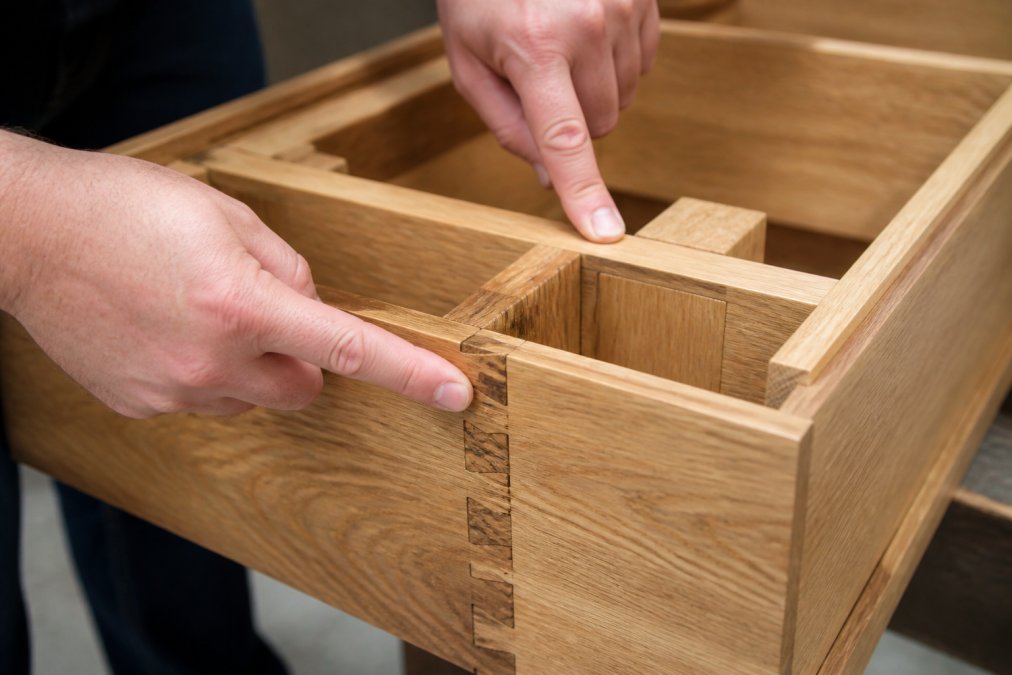
Check product photos for corner blocks, wooden or metal reinforcements at the joints where the frame meets the legs. These blocks indicate the manufacturer anticipated stress points and built in extra support. According to Baymard's 2026 furniture research, written dimensions and construction details are among the most essential product page content types for helping shoppers determine structural integrity (baymard.com).
Avoid furniture described only with vague language like "sturdy frame" or "reinforced construction." Legitimate manufacturers get specific: they name the joinery type, mention corner blocks, and explain the wood species used. If the product page doesn't include these details, that's a red flag.
Solid Wood vs Particle Board Furniture
The material difference between solid wood and particle board affects durability, weight capacity, and longevity. Solid wood costs more upfront but can be refinished, repaired, and passed down. Particle board is cheaper, but once it fails, it's done.
Solid wood is actual wood cut from trees, with a visible grain pattern that varies across the piece. If you see product photos where the grain is perfectly uniform across multiple panels, that's a sign you're looking at veneer or a photoshopped image.
81% of consumers ranked quality as the top factor in furniture purchases, and solid wood is a primary indicator consumers look for when assessing that quality (statista.com).
Veneer is a thin layer of real wood glued over a cheaper substrate like MDF or particle board. High-end furniture uses veneer on large flat surfaces to prevent warping. Legitimate sellers disclose when they use veneer. If the product description says "solid wood top with veneer sides" or "walnut veneer over hardwood plywood," that's honest. If it just says "solid wood" and the price is suspiciously low, check the fine print. Veneer over particle board will eventually peel, crack, or delaminate.
Particle board and MDF are wood byproducts compressed with adhesive. They're cheaper and lighter but can't support as much weight, dent easily, and fail when exposed to moisture. If weight capacity is listed as under 200 pounds for a dining chair or under 500 pounds for a sofa, particle board is likely involved.
Compare the price to similar-looking pieces. If one dining table is $400 and another is $1,200, that price gap reflects the real difference in durability.

How to Read Furniture Specifications Online
Product specifications are where manufacturers prove their claims. A quality brand includes detailed specs.
Start with weight capacity. This number tells you how much stress the piece can handle. A dining chair rated for 250 pounds is built differently than one rated for 300 pounds. For sofas, look for weight capacity per seat or total weight capacity. If the spec sheet doesn't list it, contact the seller.
Next, check for kiln-dried wood in the material description. This means the wood was dried in a controlled environment to remove moisture. Kiln-drying prevents warping, cracking, and movement after assembly.
Look at material sourcing details. Tropical hardwoods like acacia and teak are naturally weather-resistant and durable. Softwoods like pine are cheaper but less durable. Hardwoods from temperate zones like oak and maple are strong and long-lasting. According to Baymard's 2026 UX research on furniture shopping, dimension images and material sourcing details are critical for helping online shoppers assess structural integrity and longevity.
Check the finish. Is it stained, painted, or sealed? A quality finish protects the wood from moisture and UV damage.
Evaluate Upholstery and Fabric Durability
For upholstered furniture, the fabric and foam matter as much as the frame.
Fabric rub count (measured in "double rubs") is the standard test for upholstery durability. Fabrics rated for 15,000 double rubs are suitable for light residential use. 30,000 double rubs is medium use (typical living rooms). 50,000+ is heavy-duty (families with kids and pets). Look for this number in the product specifications.
High-density foam in cushions indicates quality. Foam density is measured in pounds per cubic foot (PCF). Standard foam is 1.5 to 2 PCF. High-density foam is 2.5 to 3+ PCF. Higher density means the cushion resists compression and lasts longer.
Spring systems in sofas and chairs add support and longevity. Eight-way hand-tied springs are the gold standard, with each spring tied individually to the frame and adjacent springs. Sinuous (S-shaped) springs are cheaper but still effective. Webbing (woven straps) alone is the budget option.
Webbing quality matters too. High-quality webbing is tightly woven and doesn't sag. You can sometimes see webbing in product photos if the seller includes underside shots. Dense, tight weaving is what you want to see.
Online furniture return rates average 19% to 20.5%, with many returns stemming from product mismatch issues. Reading these specifications upfront prevents being part of that statistic.
Use Digital Visual Inspection Techniques
You can't touch fabric or sit on a sofa through your screen, but digital tools let you inspect quality in ways that matter.
360-degree views let you rotate a piece and see it from every angle. Use these to spot construction details, fabric weave, wood grain, and finish quality. Look for inconsistencies in color, texture, or finish.

Scale images show the furniture next to a common object so you can judge actual size. This solves one of the biggest online furniture problems: pieces that look larger or smaller in photos than they are in real life.
Lifestyle photos show the furniture in a real room setting. Look for photos that show the furniture from multiple angles and in different lighting conditions. Professional styling makes everything look good, so be critical.
Check for reviewer photos in the customer reviews section. Real customers post photos of furniture in their homes, showing how it actually looks and holds up. Pay special attention to reviews from customers with similar room styles or lighting to yours.
Check Warranty and Furniture Return Policy Red Flags
A strong warranty and flexible return policy signal that the manufacturer believes in their product.
Start by reading the warranty coverage details. What does it cover? How long does it last? One year is standard. Five years or longer suggests confidence in durability. Check what's excluded. Many warranties exclude damage from misuse or normal wear, which is reasonable.
Look at assembly requirements. Does the furniture arrive fully assembled or in pieces? If assembly is required, does the seller provide clear instructions? Complicated assembly that requires special tools is a headache. Simple assembly with included hardware is manageable.
Check the return policy. How long do you have to return it? 30 days is standard. 60+ days is generous. Do you have to pay for return shipping? Some sellers cover return shipping for defective items but charge customers for returns due to preference.
Look for restocking fees. Some retailers charge 15-20% of the purchase price to process returns. This is common in furniture retail, but it's worth knowing upfront.
According to Baymard Institute, 39% of shoppers abandon carts due to extra costs appearing at final checkout, such as shipping fees and taxes. Transparent policies build trust.
Review Customer Feedback and Craftsmanship Signs
Customer reviews show long-term durability in action. A sofa might look perfect in a photo, but reviews from customers who've owned it for two years tell the real story.
Focus on reviews that mention specific durability issues. A customer who says "the cushions flattened after six months" is giving you actionable information. Read reviews with skepticism toward both extremes.
Look for reviews that mention finish quality. Has the wood developed scratches, dents, or discoloration? Is the stain or paint holding up?
Pay attention to reviews about craftsmanship. Do reviewers mention solid joinery, tight seams, or quality materials? A reviewer who says "the dovetail joints are tight and the frame doesn't wobble" is describing quality construction.
Search reviews for mentions of assembly experience. Did instructions make sense? Were all parts included? Complicated assembly sometimes indicates poor manufacturing tolerances.
Look for reviews that mention customer service. Did the seller respond quickly to issues? A brand that stands behind its products will have reviews mentioning good customer service.
Conclusion
Spotting quality furniture online comes down to reading the signals manufacturers and customers leave behind. Strong frame construction with named joinery methods, solid wood or transparent veneer disclosure, detailed specifications, high-rub-count fabrics, and clear warranties all point to quality. Digital inspection tools let you verify these details before ordering. Customer reviews confirm whether the piece holds up over time.
Downtown5 curates high-quality home goods specifically designed to eliminate this guesswork. Every piece in our collection is selected for durability, craftsmanship, and value. Our 4 Piece Patio Lounge Set with Cushions, made from solid acacia wood with reinforced corner blocks and weather-resistant construction, exemplifies the quality standards we apply across our catalog. We provide detailed specifications, multiple product photos, and seamless shipping so you can buy with confidence. Get started with Downtown5 and transform your space with furniture built to last.

=== FAQ ANSWERS (audit these too, same rules) ===
[1] Q: How can you tell if furniture is high-quality just by looking at online listings? A: Look for clear product photos showing construction details, wood grain patterns, and joinery. Check the product specifications for materials like solid wood, kiln-dried lumber, or high-density foam. Read customer reviews that mention durability and longevity. Verify that dimensions are clearly listed, and check for 360-degree views or lifestyle photos that show how the piece looks in a real space. Quality retailers provide detailed specifications and transparent material sourcing information.
[2] Q: What should I look for in online furniture product descriptions to spot quality? A: Examine descriptions for specific material names (solid acacia, kiln-dried hardwood, reclaimed wood) rather than vague terms. Look for construction details like dovetail joints, mortise and tenon connections, and corner block reinforcement. Check weight capacity, foam density ratings, and fabric rub counts for upholstery. Verify warranty length and return policies. High-quality descriptions include assembly requirements, care instructions, and sustainability certifications. Avoid listings with generic language or missing technical specifications.

[3] Q: What are red flags of low-quality furniture sold online? A: Watch for missing dimensions or vague size descriptions, lack of construction details, and absence of customer reviews mentioning durability. Be cautious of descriptions using only particle board or MDF without solid wood elements. Red flags include non-returnable cushions, warranties under one year, or return policies that charge restocking fees. Poor image quality, missing 360-degree views, or no lifestyle photos make it harder to assess fit and finish. Avoid retailers without transparent shipping costs or hidden assembly fees at checkout.
[4] Q: Does price always correlate with furniture quality online? A: Not necessarily. While 81% of consumers rank quality as the top purchase factor, price alone doesn't guarantee durability. A mid-range piece with solid wood construction and detailed specifications may outlast an expensive item made from particle board. However, extremely low prices often indicate lower-grade materials and less rigorous craftsmanship. Compare materials, construction methods, and warranty coverage across price points. Downtown5 offers competitive pricing on high-quality pieces like the 4-Piece Patio Lounge Set made from solid acacia wood at $474.36, proving that value and quality can align.
Frequently Asked Questions
Q: How can you tell if furniture is high-quality just by looking at online listings?
A: Look for clear product photos showing construction details, wood grain patterns, and joinery. Check the product specifications for materials like solid wood, kiln-dried lumber, or high-density foam. Read customer reviews that mention durability and longevity. Verify that dimensions are clearly listed, and check for 360-degree views or lifestyle photos that show how the piece looks in a real space. Quality retailers provide detailed specifications and transparent material sourcing information.
Q: What should I look for in online furniture product descriptions to spot quality?
A: Examine descriptions for specific material names (solid acacia, kiln-dried hardwood, reclaimed wood) rather than vague terms. Look for construction details like dovetail joints, mortise and tenon connections, and corner block reinforcement. Check weight capacity, foam density ratings, and fabric rub counts for upholstery. Verify warranty length and return policies. High-quality descriptions include assembly requirements, care instructions, and sustainability certifications. Avoid listings with generic language or missing technical specifications.
Q: What are red flags of low-quality furniture sold online?
A: Watch for missing dimensions or vague size descriptions, lack of construction details, and absence of customer reviews mentioning durability. Be cautious of descriptions using only particle board or MDF without solid wood elements. Red flags include non-returnable cushions, warranties under one year, or return policies that charge restocking fees. Poor image quality, missing 360-degree views, or no lifestyle photos make it harder to assess fit and finish. Avoid retailers without transparent shipping costs or hidden assembly fees at checkout.
Q: Does price always correlate with furniture quality online?
A: Not necessarily. While 81% of consumers rank quality as the top purchase factor, price alone doesn't guarantee durability. A mid-range piece with solid wood construction and detailed specifications may outlast an expensive item made from particle board. However, extremely low prices often indicate lower-grade materials and less rigorous craftsmanship. Compare materials, construction methods, and warranty coverage across price points. Downtown5 offers competitive pricing on high-quality pieces like the 4-Piece Patio Lounge Set made from solid acacia wood at $474.36, proving that value and quality can align.
This article was written using GrandRanker