

How to Organize Family Home Spaces in 2026: A Room-by-Room Guide
Table of Contents
- Why Family Homes Get Messy (And How to Fix It for Good)
- Step 1: Purge and Sort Before You Buy Anything
- Step 2: Create Zones for Every Family Activity
- Step 3: Decluttering Tips for Busy Parents Who Have No Free Time
- Step 4: Organize Family Home Spaces with Vertical Storage
- Pet-Friendly Home Organization Ideas That Survive Real Life
- Affordable Home Decor for Families That Doubles as Storage
- Your 15-Minute Daily Reset Routine
- Frequently Asked Questions
Last Updated: September 7, 2026
Why Family Homes Get Messy (And How to Fix It for Good)
The average family home fights a daily battle against clutter, and the data confirms it isn't just about laziness. A 2026 analysis of home organization statistics, drawing on research from UCLA, Princeton, and the Bureau of Labor Statistics, shows that household clutter directly impacts stress levels and time management for busy families 2026 home organization statistics analysis. At Downtown5, we understand the challenge of turning chaotic living spaces into functional hubs, and the first lesson is always the same: you cannot organize what you haven't purged.
Learning how to organize family home spaces starts with understanding that clutter is a systems problem, not a discipline problem. Every item in your home demands mental energy, a place to live, and time to maintain. When those demands exceed your family's capacity, the system breaks down.
The fix isn't buying more bins or baskets. It's building a system that matches how your family actually lives, which is exactly what this guide covers. We'll walk through a room-by-room approach that survives real life, from purging strategies to daily routines that stick.
Step 1: Purge and Sort Before You Buy Anything
The most common mistake families make is shopping for storage solutions before assessing what they actually own. Experts strongly advise against visiting home goods stores before conducting a clear assessment of your space, since buying containers first often leads to ineffective storage solutions that waste money and space.
Start with one room and sort every item into four piles: keep, donate, trash, and relocate. Be honest about what serves your family's current life stage, not the life you had before kids or the one you imagine having later. A good rule of thumb is that if you haven't used something in twelve months and it isn't seasonal or sentimental, it should go.
Work through each room systematically rather than bouncing between spaces. This purge phase typically takes longer than you expect, so block out dedicated time and resist the urge to multitask. The goal is to reduce your inventory to a manageable size before you ever think about containers or shelving.
Step 2: Create Zones for Every Family Activity
Zoning is the backbone of any organized family home. A zone assigns a specific, logical home for every activity your family performs, from homework to movie nights to meal prep. When activities have dedicated spaces, items naturally return to their zones instead of scattering across the house.
For multi-generational or care-focused living arrangements, designated care spaces are essential. The National Institutes of Health notes that homes supporting caregiving need wide doorways and halls to accommodate mobility aids and safe passage NIH research on home design for caregiving. Even if you aren't caring for extended family now, planning for accessibility makes your home more adaptable.
Create zones by asking where each activity naturally happens, then place storage within arm's reach of that spot. Homework supplies belong near the desk, not in a hallway closet. Sports gear needs a home near the entry point, not in the basement. This principle applies across every room in the house.
Step 3: Decluttering Tips for Busy Parents Who Have No Free Time
Most organizing guides assume parents have a free weekend to overhaul a room. They don't. But the deeper problem isn't time, it's that families treat clutter as a storage issue when it's actually a behavioral loop. Every item that lands on the counter or floor is a decision deferred. The fix is to shorten the time between 'item out of place' and 'item back in its zone' until the loop becomes automatic.
The 15-Minute Method, Refined
The basic version of this method, set a timer and tackle one drawer, works, but it fails when you don't know what to tackle. Instead, keep a running 'hotspot list' on your phone. For one week, note the exact spots where clutter accumulates daily: the kitchen island, the entry bench, the foot of the stairs. At the end of the week, you'll have a ranked list of your family's top five clutter generators. Spend your 15-minute sessions on those specific spots, not on random drawers. This turns a vague chore into a targeted fix.
The Emotional Side of Letting Go
A 2026 analysis of home organization statistics, drawing on research from UCLA, Princeton, and the Bureau of Labor Statistics, shows that household clutter directly impacts stress levels and time management for busy families 2026 home organization statistics analysis. That stress often comes from the emotional weight of items tied to memories or guilt, the outgrown baby clothes, the unread books, the craft supplies for a hobby you abandoned. The single biggest blocker to purging often isn't laziness; it's the fear of losing a version of yourself or your child.
A practical mechanism to break this loop is the 'photo keep' method. Instead of holding onto an item for its memory, take a photo of it, save it to a folder labeled 'Keepsakes,' and let the physical item go. This satisfies the emotional need to preserve the memory without the physical burden. For items tied to guilt, the expensive gadget you never used, reframe the cost as a lesson learned, not a reason to keep the item. The money is already spent; the item is now costing you square footage and mental energy.
Age-Appropriate Tasks That Actually Build Habits
Most guides say 'involve the kids' without explaining how. The breakdown matters because a toddler and a teenager need completely different mechanisms to build ownership.
- Ages 2-4: Toddlers respond to visual cues, not verbal instructions. Use color-coded bins (red for blocks, blue for cars) and make clean-up a game, 'Let's see who can get the red blocks in the red bin before the song ends.' Do not expect them to sort by category beyond one attribute. Their job is to match the item to the color, not to decide where things live.
- Ages 5-7: School-age kids can handle two-step tasks: put the toy on the shelf, then push the bin back. Assign them one zone that is entirely theirs, a toy shelf or a low drawer, and let them own it completely. If they leave it messy, resist the urge to fix it. The mess is their system, and they need to see the consequence of not maintaining it.
- Ages 8-12: This is the sweet spot for teaching the 'one in, one out' rule. Before a birthday or holiday, have them choose one toy to donate for every new one they receive. This makes the rule concrete rather than abstract. They can also manage their own backpacks and school papers, but they need a clear home for each category, a hook for the backpack, a tray for permission slips, a bin for completed art.
- Teens: Teens respond to autonomy, not chore charts. Give them full ownership of their room and their closet, but set a boundary: common areas stay tidy, and their room is their domain as long as it doesn't smell or attract pests. If their room becomes a disaster, resist the urge to clean it for them. Instead, ask what system they need, a hamper closer to the bed, more hangers, a shelf for their gaming gear, and help them implement it. Teens who are given control over their space are often more likely to maintain it than those who are nagged.
The 'One In, One Out' Rule, Made Realistic
The 'one in, one out' rule prevents future buildup, but it fails when families don't agree on what counts as 'out.' A common pattern is that parents enforce it on toys but exempt their own purchases, new kitchen gadgets, clothes, or decor. The rule only works if it applies to everyone. Make it a family rule, not a parental rule. When a new item enters the home, the owner of that category must choose what leaves. If no one can decide, the new item waits in the garage for 48 hours before it comes inside. This cooling-off period often reveals that the new item wasn't essential after all.
Step 4: Organize Family Home Spaces with Vertical Storage
Vertical space is the most underutilized asset in most family homes. Double rods and cascading hangers in closets can effectively double your hanging capacity, while wall-mounted systems transform blank walls into storage powerhouses 2026 trending home organization methods. When floor space is limited, the answer is always to go up.
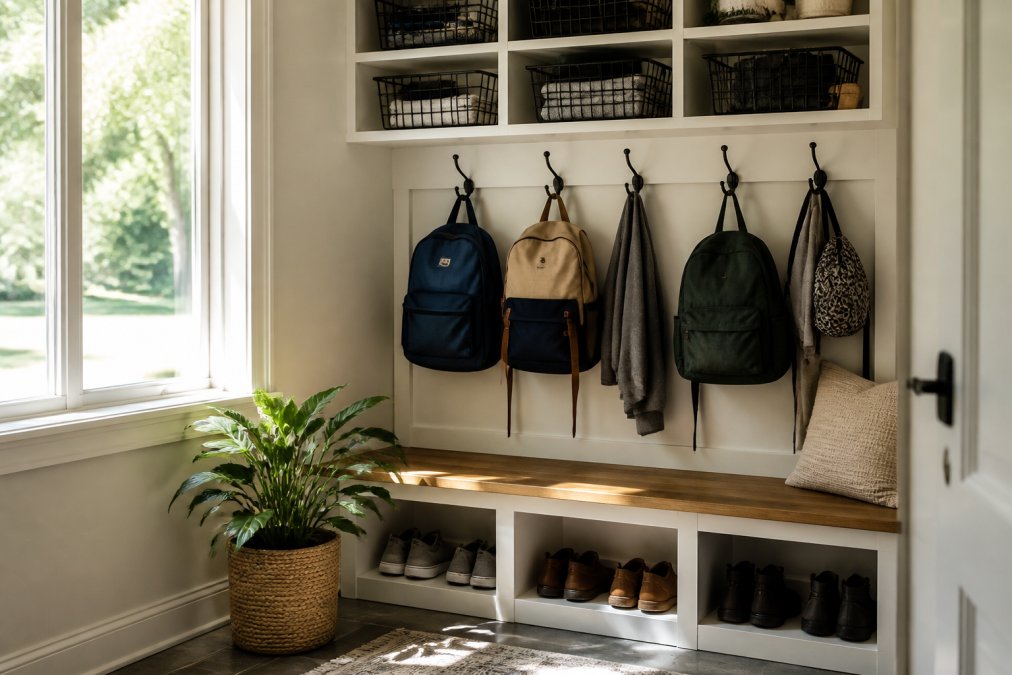
Start with the areas that generate the most daily chaos: entryways, mudrooms, and kids' closets. Install hooks at child height so kids can hang their own coats and backpacks. Use clear, labeled bins on upper shelves for items you access less frequently, and keep everyday essentials at eye level.
For small parts that constantly get lost, consider a wall-mounted bin system. The Wall Mounted Storage Bins 48-Bin Organizer from Downtown5 mounts directly to the wall, freeing valuable floor and drawer space while keeping craft supplies, hardware, and small toys sorted and visible. At $89.70, it's a budget-friendly way to add 48 labeled compartments to any room.

Pet-Friendly Home Organization Ideas That Survive Real Life
Pet-friendly home organization ideas must account for the fact that animals don't respect your systems. Food bowls, leashes, toys, and grooming supplies need dedicated, accessible homes that work for both you and your pet.
Designate a pet station near the door where you keep leashes, waste bags, and wipes. Store food in airtight containers that are easy for you to access but impossible for pets to open. Use a basket or bin for toys that family members can quickly toss items into at the end of the day.
Choose materials that withstand daily wear. Woven baskets look beautiful but won't survive a dog that likes to chew. Opt for durable plastic, metal, or treated wood that cleans easily and resists scratches, fur, and accidents.
Affordable Home Decor for Families That Doubles as Storage
Affordable home decor for families should serve double duty, providing both style and function without breaking the budget. Multi-functional furniture, such as ottomans with hidden storage, benches with lift-up seats, and coffee tables with drawers, maximizes utility in shared living areas.
Look for pieces that conceal visual noise while adding character to a room. A wrought iron room divider can separate a play area from a living space while adding rustic charm and hiding the chaos behind it Homes.com 2026 new-home buyer survey. Decorative baskets, wall-mounted shelves, and storage benches all contribute to a cohesive look while keeping household items out of sight.

| Storage Solution | Best For | Price Range | Durability |
|---|---|---|---|
| Wall-mounted bin systems | Small parts, crafts, hardware | $89.70 | High (PP plastic) |
| Multi-functional furniture | Living rooms, small spaces | Varies | Medium to high |
| Decorative baskets and bins | Toys, blankets, everyday items | Low | Medium |
| Vertical shelving units | Closets, pantries, entryways | Varies | High |
The key is to purchase pieces that match your existing decor so storage feels intentional rather than utilitarian. This approach keeps your home looking curated while remaining practical for daily family life.
Your 15-Minute Daily Reset Routine
A daily reset routine is what separates organized homes from homes that look organized once a month. Set aside fifteen minutes each evening to return items to their zones, clear countertops, and prepare for the next morning. This habit prevents the gradual creep of clutter that undoes your organizing work.
Assign each family member a specific reset task based on their age and ability. A preschooler can put toys in bins, a grade-schooler can clear the dining table, and parents can handle the kitchen counters and living room. When everyone contributes, the reset takes minutes instead of hours.
The most successful families treat the reset as non-negotiable, like brushing teeth. It becomes part of the evening rhythm rather than a chore to negotiate. After two weeks, the habit becomes automatic, and you'll notice the difference in how your home feels each morning.
Frequently Asked Questions
What is the 3-3-3 rule for decluttering?
The 3-3-3 rule is a simple method: identify 3 things to throw away, 3 things to donate, and 3 things to put back in their proper place. It takes about 10 minutes and works well for busy parents because the goal is small and finishable. Try it in the living room or family entryway after school pickup. The rule builds momentum without feeling overwhelming, and it trains kids to make quick decisions about their belongings.
How do you organize a family home with limited storage?
Focus on vertical space first. Install double rods in closets, use over-the-door organizers, and mount shelves above doorways. Look for multi-functional furniture like ottomans with hidden storage or benches that open. Use the 12-12-12 rule during your initial purge: 12 items to toss, 12 to donate, and 12 to return to their proper room. This prevents you from buying more bins than you actually need.
What are the best pet-friendly home organization ideas?
Designate a low cabinet or basket for pet supplies so kids can help feed and groom without asking where things go. Use washable, machine-cleanable storage bins for toys and blankets. Keep pet food in airtight containers on a sturdy shelf that dogs cannot reach. Place a wall-mounted towel rack near the back door for quick paw wipes, and store leashes on hooks at kid height so children can join walks safely.
How can I maintain an organized home with children and pets?
Build a 15-minute daily reset into your evening routine. Set a timer and walk through the main living areas returning items to their zones. Assign each family member a color-coded bin or basket for their personal items. Involve kids in weekly tidy sessions with age-appropriate tasks like sorting toys or matching shoes. Consistency beats perfection: a home that gets messy daily and reset nightly stays functional.
Organizing a family home isn't about achieving Pinterest-perfect spaces. It's about creating systems that reduce daily friction and give your family more time for what matters. Downtown5 offers durable storage solutions like wall-mounted bin systems and room dividers that help you organize family home spaces without sacrificing style, backed by seamless shipping and quality you can count on. Get started with Downtown5 and build a home that works as hard as your family does.