

Ergonomic Garden Tools for Arthritis: 2026 Review
Table of Contents
- Why Ergonomic Garden Tools for Arthritis Sufferers Matter
- Garden Tools for Arthritic Hands: What to Look For
- Ratchet Pruners for Arthritis: How They Reduce Hand Strain
- Long-Handled Gardening Tools for Less Bending and Reaching
- Top Picks: Ergonomic Garden Tools Reviewed
- Budget Tiers: What to Expect at Each Price Point
- Maintenance and Safe Use of Adaptive Garden Tools
- Frequently Asked Questions
Last Updated: October 12, 2026
Why Ergonomic Garden Tools for Arthritis Sufferers Matter
Gardening should not cost you a day of throbbing hands. The Arthritis Foundation's guidance on helpful garden tools makes the case plainly: the right tool reduces joint stress before the damage starts, not after.
A standard trowel forces your fingers into a tight curl and your wrist into an awkward angle, and every scoop multiplies that strain. An ergonomic handle redistributes the load across your palm and forearm, so the tool does the work your joints cannot.
Garden Tools for Arthritic Hands: What to Look For
Garden tools for arthritic hands share three traits: a thick, cushioned grip, a neutral wrist position, and a weight you can lift without bracing.
But grip alone does not tell you which tool to buy. Match the tool to the task, then the task to your limitation: stiffness, reduced grip strength, wrist pain, and difficulty bending each point toward a different tool shape.
Match the Tool to the Task
| Task | Tool category | What the ergonomic version changes |
|---|---|---|
| Planting and potting | Hand trowel, transplanter | Thick offset handle keeps the wrist straight; depth markings reduce re-measuring |
| Weeding | Stand-up weeder, hand weeder, hoe | Long shaft removes bending; a lever or fulcrum head replaces grip force with body weight |
| Digging and turning soil | Garden fork, spade | D-handle or T-handle spreads load across the palm; step ledge lets you use a foot instead of a hand |
| Cultivating and loosening | Hand cultivator, oscillating hoe | Padded grip and a push-pull head reduce wrist rotation |
| Pruning | Bypass pruner, ratchet pruner, lopper | Ratchet or geared mechanism cuts in stages; rotating handle follows the hand |
| Reaching and raking | Long-handled rake, telescoping tools | Lightweight shaft and adjustable length reduce overhead and forward reach |
Match the Tool to Your Limitation
- Stiff, painful fingers: Prioritize the largest grip diameter you can comfortably hold (roughly 1.25 to 1.5 inches for most adults) and tools with a trigger or lever you can work with the heel of your hand rather than a fingertip pinch.
- Reduced grip strength: Look for ratchet pruners, geared loppers, and lever-based weeders that convert a light squeeze into a full cut or pull. Battery-powered shears supply the cutting force entirely.
- Wrist pain or limited rotation: Choose offset or angled handles that keep the wrist neutral, and avoid tools that require twisting, such as a standard hand weeder.
Grip Design and Handle Shape
Handle shape decides how much your hand has to work. An ergonomic handle has a contoured profile matching the natural curve of a relaxed grip, often with a soft, padded surface. Look for:
- Diameter: roughly 1.25 to 1.5 inches for most adults, larger than a standard trowel handle
- Material: rubberized or foam padding over a rigid core, which cushions without flexing
- Shape: contoured or offset, so the wrist stays straight rather than bending sideways
A padded grip can extend comfortable gardening time, especially on cool mornings.
Weight, Balance, and Reach
Weight and balance matter as much as grip. A light but front-heavy tool still tires your wrist because you fight the load the whole time; balanced tools feel lighter than they are. Reach length decides how much you bend and stretch, often the limiting factor for reduced hip or spine mobility. Long-handled gardening tools let you work standing or seated, removing the repeated bending that sends pain through the lower back.
Ratchet Pruners for Arthritis: How They Reduce Hand Strain
Ratchet pruners for arthritis cut in stages rather than one squeeze.
A standard bypass pruner demands one continuous squeeze, with resistance peaking right when your grip is weakest. A ratchet pruner breaks the same cut into two or three lighter squeezes.
Look for a ratchet pruner with a rotating or ergonomic handle, a one-hand locking mechanism, and a blade that stays sharp.
Long-Handled Gardening Tools for Less Bending and Reaching
Long-handled gardening tools are the biggest comfort upgrade for anyone with reduced mobility, moving the work from your back and knees to your arms and shoulders.
The selection criteria are straightforward:
- Reach length: long enough that you stand straight, short enough to control
- Handle material: lightweight fiberglass or aluminum over heavy wood or steel
- Grip: the same thick, cushioned design as hand tools, sized for a relaxed hold
For raised beds or containers, a mid-length handle often beats a full-length one, because you can work seated with the tool close to your body. The goal is the shortest handle that still keeps your back straight and your wrist neutral.
Top Picks: Ergonomic Garden Tools Reviewed
The tools below are the ones we carry at Downtown5, chosen because each removes a specific strain point rather than just adding padding. Each entry lists the same four criteria: handle shape, weight, reach, and grip size.
Manual Pole Saw for High Branches
The Manual Pole Saw, 7.3-27 ft Extendable Tree Pruner is our pick for high branches when you would rather not climb or haul a ladder. It extends from 7.3 to 27 feet so you trim from the ground, and the lightweight fiberglass pole keeps the whole tool at 11.2 pounds. The PTFE-coated double-hook steel blade cuts on both the push and pull stroke, reducing repeated effort per branch.
- Handle shape: Straight fiberglass pole with lock buckles
- Weight: 11.2 lb
- Reach: 7.3-27 ft, adjustable
- Grip size: Standard pole diameter, best with padded gloves
Cordless Pole Saw and Hedge Trimmer Combo
The DEWALT 20V MAX Cordless Pole Saw and Pole Hedge Trimmer Combo Kit covers two jobs with one battery system.
Gardening Fruit Tree Garden Branch Shears Handheld Electric Lithium Battery Elec →
- Handle shape: Straight pole with articulating head
- Weight: Battery-dependent, heavier than manual
- Reach: 15 ft saw, 12 ft trimmer
- Grip size: Standard, with trigger
If you only need the saw, the DeWalt 20V MAX 8 inch Cordless Pole Saw Kit does the same 15-foot reach with an 8-inch low-kickback bar and chain, an automatic oiling system, and up to 96 cuts per charge. At $352.52, it costs less than the combo and carries a longer 3-year warranty.
Electric Branch Shears for Light Pruning
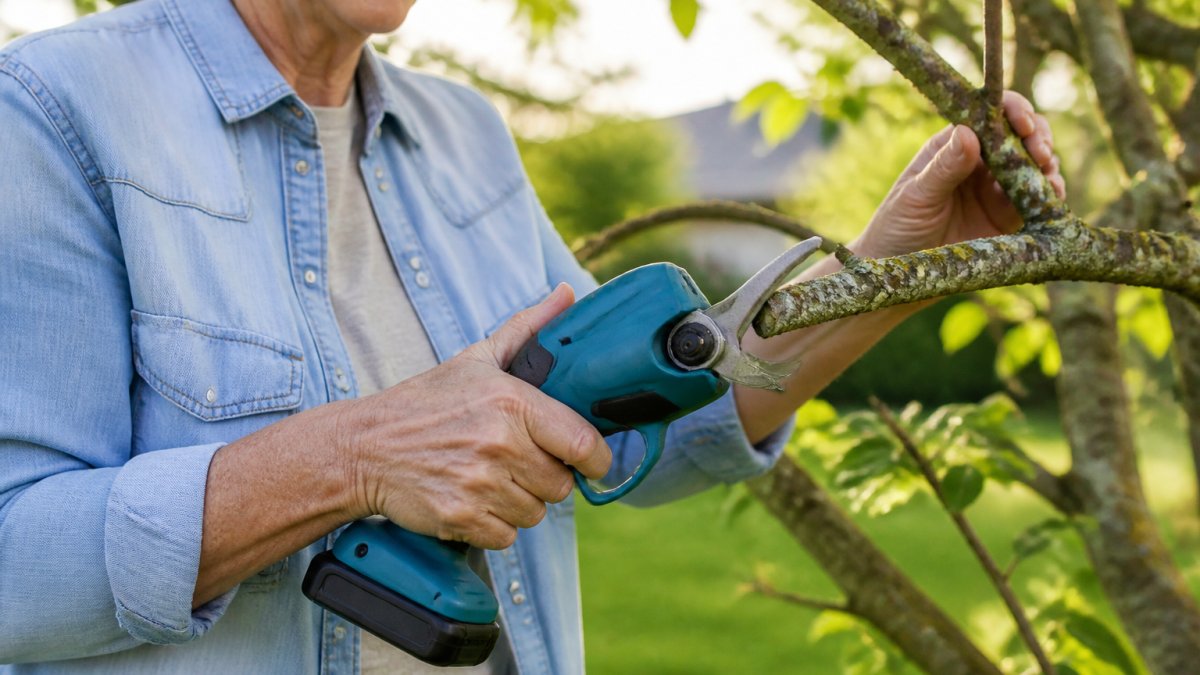
The Gardening Fruit Tree Garden Branch Shears are handheld electric scissors built for fruit branches and light pruning.

- Handle shape: Pistol-style with trigger
- Weight: Handheld, battery in grip
- Reach: Arm's length
- Grip size: Compact, one-handed
For maximum reach with the least physical effort, the Milwaukee Tool M18 Cordless Brushless Telescoping Pole Pruning Shears Saw combines a telescoping pole with a brushless motor. At $653.55, it is the premium option for large properties where reach and power both matter.
Hand Tools for Planting, Weeding, and Cultivating
Powered tools cover pruning and reach, but most garden work happens at ground level. Compare these categories when grip strength and wrist pain are the main limits.
- Ergonomic hand trowel: Look for an offset, padded handle and a stainless blade with depth markings. The offset keeps the wrist straight during scooping, and the markings cut down on repeated measuring. Best for planting and potting.
- Stand-up weeder: A long shaft with a lever or foot pedal lets you pull weeds from a standing position and use body weight instead of grip force. Best for anyone who cannot kneel or bend.
- Ratchet pruner: Cuts in two or three lighter squeezes instead of one full closure. Best for branches that resist a standard bypass pruner.
- Long-handled cultivator: A push-pull head with a padded grip loosens soil without wrist rotation. Best for raised beds and between-row work.
Comparison at a Glance
| Tool | Price | Reach | Handle shape | Best for |
|---|---|---|---|---|
| Manual Pole Saw | $141.42 | 7.3-27 ft | Straight pole | High branches, no climbing |
| DEWALT Pole Saw + Hedge Trimmer Combo | $408.47 | 15 ft saw, 12 ft trimmer | Articulating head | Trees and hedges together |
| DeWalt 8 inch Pole Saw Kit | $352.52 | 15 ft | Straight pole | Sawing only, longer warranty |
| Electric Branch Shears | $295.71 | Handheld | Pistol grip | Grip strength is the limit |
| Milwaukee Telescoping Pole Saw | $653.55 | Telescoping | Straight pole | Large properties, max power |
| Ergonomic hand trowel | Varies | Arm's length | Offset, padded | Planting and potting |
| Stand-up weeder | Varies | Standing height | Long shaft, lever | Weeding without bending |
| Ratchet pruner | Varies | Arm's length | Contoured | Branches that resist a standard cut |
Budget Tiers: What to Expect at Each Price Point
Spending more buys reach, power, and battery capacity, not just brand name. The manual pole saw at $141.42 covers high branches with zero fuel or charging and rewards steady arms over strong hands.

Value over time depends on how often you garden. If you trim a few branches a season, the manual pole saw pays for itself in one avoided ladder.
Maintenance and Safe Use of Adaptive Garden Tools
Adaptive garden tools last longer when you keep blades sharp, batteries charged, and grips clean. A sharp blade needs less force to cut, which is the whole point of an ergonomic tool.
Follow this routine:
- Wipe grips after each use to keep the padded surface tacky and non-slip
- Sharpen blades each season or whenever cutting starts to feel like work
- Store tools indoors or in a dry shed to protect handles and battery contacts
- Charge batteries fully before storage and never leave them in a cold garage
- Oil the bar and chain on pole saws before each session
- Check lock buckles and collars on extendable poles before extending them
Safe use matters as much as maintenance. Never cut overhead with a manual pole saw while standing under the branch; keep both feet planted and the pole angled away from your body.

Frequently Asked Questions
What garden tools are best for people with arthritis?
Tools with thick, cushioned grips and long handles reduce joint stress. Ratchet pruners, upright weeders, and extendable pole saws let you work with a neutral wrist and less bending. For pruning high branches, a manual pole saw like the VEVOR 7.3-27 ft model ($141.42) keeps both feet on the ground. Electric shears and cordless pole saws also cut the force needed per cut, which matters when grip strength is limited.
Are ratchet pruners easier to use with arthritis?
Yes. Ratchet pruners use a geared mechanism that multiplies your squeezing force, so you need less hand strength to make a cut. For very small branches, electric shears can eliminate squeezing altogether.
How can I make gardening easier on arthritic hands?
Start with long-handled tools to avoid bending and stretching. Use a garden stool or kneeler to keep your wrists neutral. Wear padded gloves for extra support. Take breaks every 20 to 30 minutes and switch tasks to avoid repeating the same grip. Keep tools sharp so you use less force. A lightweight pole saw or electric shear can replace manual pruning for many jobs.
Are long-handled garden tools helpful for arthritis?
Long-handled tools reduce bending, reaching, and wrist strain. A pole saw that extends from 7.3 to 27 ft lets you trim high branches without a ladder. Long-handled cultivators and weeders keep your back straight and your hands in a comfortable position. Choose handles with a padded grip and a diameter that fits your hand, usually 1.25 to 1.5 inches for arthritic hands.
What gloves are best for gardening with arthritis?
Padded gloves absorb vibration and reduce pressure on joints. Look for a snug but not tight fit, and check that the fingertips allow you to feel what you're doing.
Arthritis changes which tools work, but it does not have to end your garden. The fix is matching each task to a tool that removes the specific strain it causes, whether that is reach, grip force, or bending. Downtown5 curates reliable garden tools alongside the home goods that make daily life easier, with high-quality products, seamless shipping, and incredible value. Browse our garden tool selection and find the ergonomic pick that keeps you gardening comfortably.