

Best Rust Prevention Tips for Garden Tools
Table of Contents
- Why Garden Tools Rust and What It Costs You
- Rust Prevention Tips: Clean and Dry After Every Use
- How to Remove Rust from Garden Tools Before It Spreads
- The Best Oil for Garden Tool Maintenance (and What to Skip)
- Garden Tool Storage Ideas That Block Moisture Year-Round
- Material-Specific Care: Carbon Steel, Stainless, and Handles
- Winterizing and Long-Term Storage for Rust Prevention
- Conclusion
- Frequently Asked Questions
Last Updated: October 1, 2026
Why Garden Tools Rust and What It Costs You
Rust is the single biggest killer of garden tools, starting the moment bare steel meets moisture and oxygen. Every year, homeowners replace pruners, trowels, and shovels that twenty minutes of seasonal care could have saved.
Colorado State University Extension guidance on garden tool care
Rust Prevention Tips: Clean and Dry After Every Use
The single most effective rust prevention habit: clean and dry your tools before they go back in the shed, every time. Moisture left on a blade for even a few hours begins the oxidation process.
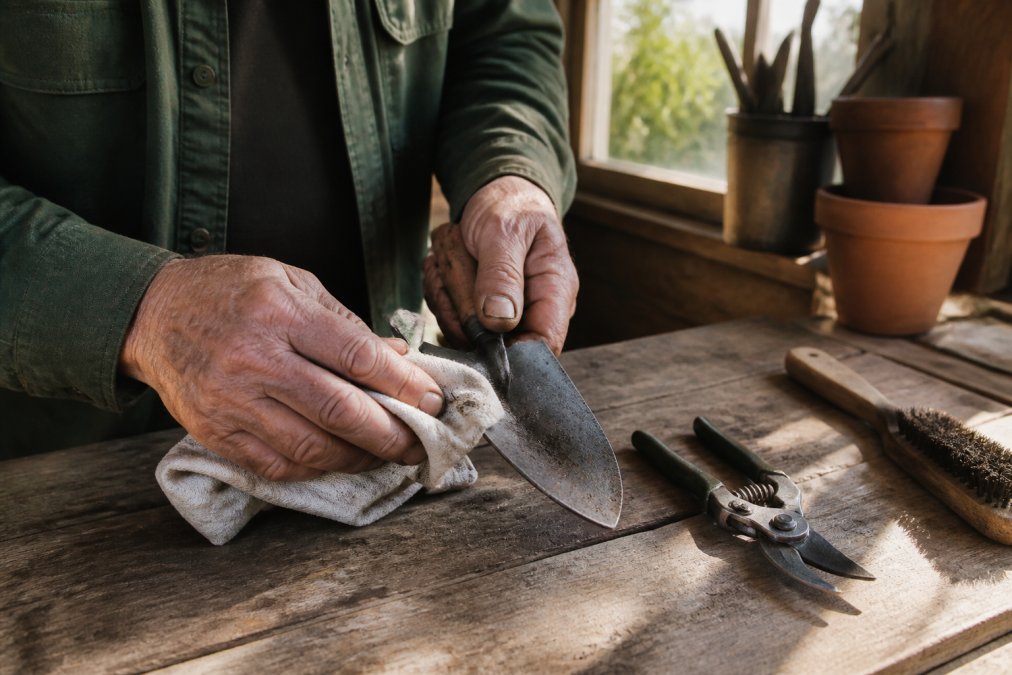
- Knock off loose soil with a stiff brush or old rag
- Wipe the blade and pivot point with a dry cloth
- Check for hidden moisture in joints and handles
- Apply a thin oil coat before storage
How to Remove Rust from Garden Tools Before It Spreads
Surface rust is easy to remove; pitting is not. The moment you spot orange discoloration, treat it. Waiting lets corrosion eat into the metal and weaken the blade edge permanently.

Start with the gentlest method and work up:
- Light surface rust: Scrub with steel wool and a few drops of oil
- Stubborn patches: Use a wire brush or fine sandpaper, working along the grain
- Heavy corrosion: Soak in white vinegar for a few hours, then scrub and rinse thoroughly
- After any method: Dry completely and apply a protective coating immediately
The Best Oil for Garden Tool Maintenance (and What to Skip)
There is no single "best" oil, only the best oil for the job in front of you. Understand the three mechanisms and the choice becomes obvious.
How protective oils actually work on steel:
- Barrier films (mineral oil, camellia oil, motor oil) sit on the surface and physically block oxygen and water from reaching the iron. They work immediately but wipe off with use.
- Solvent-carrier penetrants (penetrating oils like 3-in-One, WD-40) carry a thin lubricant into pivot points and micro-pits, then the solvent flashes off. Great for hinges and seized joints, weak as a long-term coating.
- Drying oils (boiled linseed oil, tung oil) polymerize on contact with air into a hard, cross-linked film. The film is durable and slightly sacrificial, it wears instead of the steel.
That framework explains every recommendation below.
| Product | Mechanism | Best For | Real Trade-Off |
|---|---|---|---|
| Penetrating oil (3-in-One, WD-40) | Solvent-carrier penetrant | Pivot points, hinges, post-cleaning wipe-down | Evaporates; needs reapplication every few weeks |
| Boiled linseed oil | Drying oil | Seasoning blades, heads, wooden handles | 24-72 hour cure; rags can self-ignite if balled up |
| Camellia oil | Barrier film (plant-based) | Food-safe gardens, Japanese blades, pruners | Lighter film than linseed; pricier per ounce |
| Mineral oil | Barrier film | Sand-bucket storage, food-contact surfaces | Attracts grit if over-applied; needs refreshing |
| Tung oil | Drying oil | Long-term storage coatings | Slower cure than linseed; harder film |
| Motor oil | Barrier film | Old-school rust coating on shovels and hoes | Contains additives not intended for skin or soil contact |
Match the oil to the tool, not the shelf:
- Carbon steel blades and heads: Boiled linseed oil for the seasonal seasoning coat, penetrating oil for weekly touch-ups. Carbon steel has no alloy protection, so the film is the only defense.
- Stainless steel: A light barrier oil is enough. Stainless relies on its chromium oxide layer; you are only protecting the fasteners and any scratched areas where that layer is compromised.
- Pivot points and springs: Penetrating oil only. Drying oils will gum up a hinge and make pruners stiff.
- Wooden handles: Boiled linseed oil, applied thin and wiped dry. It soaks into the grain, prevents swelling and cracking, and does not leave a tacky surface if you buff off the excess.
- Food-contact surfaces (harvest knives, trowels used near edibles): Camellia or mineral oil. Both are food-safe; motor oil is not.
Extension guidance on tool lubricants and protective coatings
Garden Tool Storage Ideas That Block Moisture Year-Round
Storage is where most rust prevention succeeds or fails, and "store tools dry" means something completely different in coastal humidity than in a high-desert climate. Here is the storage playbook, organized by the conditions your tools actually live in.
The three forces that drive rust in storage:
- Liquid water, rain, hose spray, damp soil, condensation dripping from a metal roof.
- Ambient humidity, water vapor in the air. Above roughly 60% relative humidity, bare steel starts to corrode even without visible moisture.
- Temperature swings, a cold night followed by a warm day causes condensation to form on cold metal, the same way a glass of iced tea sweats in summer.
The sand-and-oil bucket (still the best hand-tool method)
Fill a 5-gallon bucket two-thirds with clean play sand, then mix in about a cup of mineral oil until the sand feels slightly damp, not wet. Plunge hand tools blade-first: the sand scours off soil and the oil leaves a thin film on the metal every time you insert or remove the tool. Refresh the oil every few months. It's the most efficient storage method for trowels, hand pruners, weeders, and cultivators because it combines cleaning and coating in one motion.
Wall racks and vertical hanging
Long-handled tools, shovels, hoes, rakes, edgers, should hang vertically with blades up or off the floor, for airflow and edge protection. A shovel blade resting on concrete sits on a cold, often damp surface that wicks moisture. A wall-mounted rack or a pair of screws with coated hooks solves this for under $20.
1/2 in. Mesh Welded Wire Fence Hardware →
Climate-specific storage: the gap most guides miss
High-humidity and coastal climates (Southeast, Gulf Coast, Pacific Northwest):
- Assume ambient humidity is working against you year-round. A sealed cabinet with a rechargeable silica gel desiccant is not optional, it is the baseline.
- Refresh oil coatings monthly, not seasonally. The film breaks down faster in humid air.
- Avoid unheated detached sheds if possible. If that is your only option, store hand tools indoors in a garage or mudroom.
- Consider a plug-in goldenrod dehumidifier rod inside a closed cabinet. These are inexpensive and keep the interior a few degrees above ambient, which prevents condensation.
Arid and high-desert climates (Southwest, intermountain West):
- Ambient humidity is low, so the main threat is not vapor but temperature swings and irrigation overspray.
- Tools stored in an uninsulated shed can still sweat on cold mornings after a warm day. Keep them off concrete and out of direct sun.
- Oil coatings last longer here, every two to three months is usually enough.
- Dust is the bigger nuisance. A covered bin keeps grit out of pivot points.
Cold-winter climates (Upper Midwest, Northeast, mountain states):
- The freeze-thaw cycle is the enemy. Condensation forms on cold metal every time the shed warms up.
- Bring hand tools indoors for the winter. Long-handled tools can stay in the shed if they are oiled heavily and hung off the floor.
- Drain and dry any tool that holds water, sprayers, watering cans, hose reels.
Long-term winterizing: the multi-month storage checklist
Most guides cover daily care and stop there, but winter storage is where the real damage happens, tools sit untouched for three to five months. Run this checklist before the first hard freeze:
- Clean every tool with a wire brush and rag; remove all soil and sap
- Treat any existing rust with steel wool, vinegar, or a wire wheel
- Dry completely, including pivot points and hollow handles
- Sharpen blades now, not in spring; a sharp edge holds oil better than a rough one
- Apply a heavy coat of boiled linseed oil or a barrier oil to all bare metal
- Oil pivot points and springs with penetrating oil
- Store off the floor, hung vertically where possible
- Add rechargeable desiccant packs to any enclosed cabinet
- Drain fuel from gas-powered equipment and oil exposed metal
- Photograph your setup so you can compare in spring
Desiccants: what actually works
Silica gel packs are the standard, but they saturate. Rechargeable options (the kind you dry in an oven or microwave) are worth the small premium because you can reuse them for years. Calcium chloride desiccants pull more moisture but are messy and corrosive if they leak, keep them in a tray, never directly against tools. For a small cabinet, one 500-gram rechargeable pack is usually enough; for a full shed, improve airflow instead.
Material-Specific Care: Carbon Steel, Stainless, and Handles
Not all garden tools rust the same way, so care should match the material. Carbon steel takes a sharp edge easily but rusts fast without protection. Stainless steel resists corrosion thanks to its chromium content, but still stains and pits in prolonged moisture. Aluminum handles and fiberglass shafts won't rust, but their fasteners and pivot points will.
Match your maintenance to the material:
- Carbon steel blades: Oil after every use, season quarterly with boiled linseed oil
- Stainless steel: Wipe dry, oil occasionally, don't assume it's rust-proof
- Wooden handles: Sand lightly, treat with linseed oil to prevent cracking and swelling
- Fiberglass and aluminum: Focus oil on bolts, springs, and connection points
Winterizing and Long-Term Storage for Rust Prevention
Winterizing is where most rust damage actually happens: tools sit for months in cold, damp conditions with no airflow, and by spring rust has spread across every unprotected surface.
Before the first freeze, run through this checklist:
- Clean every tool thoroughly with a wire brush and rag
- Remove any existing rust with steel wool or vinegar
- Dry completely, then apply a heavy coat of oil or linseed oil
- Sharpen blades and oil the pivot points
- Store tools off the floor in a dry, ventilated space
- Add desiccant packs to enclosed storage
- Hang long-handled tools vertically to protect blade edges
Conclusion
Rust prevention isn't complicated, but it is relentless. Moisture finds every unprotected surface, and the tools that survive are the ones dried, oiled, and stored properly every single time.
Frequently Asked Questions
What should I put on garden tools to prevent rust?
A penetrating oil like 3-in-One works well for coating metal surfaces and pivot points. Master Gardeners at Colorado State University recommend linseed oil or camellia oil as excellent protectants for garden tools. Apply a thin layer after cleaning and drying. Avoid lightweight spray lubricants, which evaporate too quickly to provide lasting protection.
Will WD-40 keep garden tools from rusting?
WD-40 can displace moisture and offer short-term protection, but it is not a long-term rust preventative. Experts recommend penetrating oils over spray lubricants because sprays evaporate too fast. For tools stored through humid months or winter, use a heavier protective coating like boiled linseed oil or camellia oil and reapply as needed.
How do I remove existing rust from garden tools?
Start with a wire brush or steel wool to scrub surface rust, then follow with sandpaper for stubborn spots. For deeper corrosion, apply a penetrating oil and let it sit before scrubbing. After removal, degrease the metal with mineral spirits, dry it completely, and apply a protective coating to prevent the rust from returning.
Should I store my garden tools in a bucket of sand?
A sand-and-oil bucket is a widely cited method for cleaning and coating hand tools at the same time. Fill a bucket with sand and mix in mineral or vegetable oil, then plunge tools in after each use. The sand scours off dirt while the oil leaves a thin protective film. Keep the bucket in a dry, covered area to avoid moisture buildup.
How often should I oil my pruning shears and other tools?
Oil pruning shears and other cutting tools after every use, especially if you worked in damp soil or cut wet plant material. At minimum, oil weekly during growing season and monthly during storage. Focus on the blade edge and pivot point, where moisture collects and oxidation starts. A quick wipe with an oiled cloth takes under a minute.