

Best Eco-Friendly Cleaning Supplies for Homes 2026
Table of Contents
- Quick Comparison: Top Eco-Friendly Cleaning Supplies
- How to Choose Green Cleaning Products
- Best Eco-Friendly Cleaning Supplies for Every Room
- Pet-Safe Cleaning Products for Homes with Animals
- Refillable Cleaning Systems and Sustainable Packaging
- How to Switch to Green Cleaning Without Wasting Money
- Common Mistakes When Buying Eco-Friendly Cleaning Supplies
- Conclusion: Building a Greener Cleaning Routine
- Frequently Asked Questions
Last Updated: September 26, 2026
Quick Comparison: Top Eco-Friendly Cleaning Supplies
The household cleaning products market is projected to reach $15.36 billion in 2026, and eco-friendly options are driving much of that growth, according to Fortune Business Insights' household cleaning products market analysis. This guide from Downtown5 cuts through the greenwashing to show you which eco-friendly cleaning supplies actually earn their shelf space in a home.
| Product | Price | Best For | Key Feature |
|---|---|---|---|
| Supersonic Smart Robot Vacuum | $175.76 | Floors and carpets | HEPA filter, 100-min runtime |
| Ultrasonic Cleaner (2L) | $121.15 | Jewelry, glasses, small parts | Digital timer and heater |
| Window Cleaner Robot | $349.60 | Glass and windows | Automatic operation |
| Chenille Wash Mitts | $78.19 | Car wheels, scratch-free washing | Waterproof microfiber |
| Electric Brush Scrubber | $46.97 | Makeup brushes | Silicone case, portable base |
How to Choose Green Cleaning Products
Choosing green cleaning products comes down to four checks: certification, ingredient disclosure, fragrance source, and packaging format. A product that can't answer all four clearly is a marketing exercise, not a cleaning product.

Certifications That Matter: EPA Safer Choice
The EPA Safer Choice ecolabel is the most rigorous third-party verification available for household cleaners. Products carrying it have been reviewed ingredient by ingredient against the Safer Chemical Ingredients List, and the EPA re-reviews the formulation when a manufacturer changes it. That ongoing review is the part most green labels skip.
Other labels worth knowing:
- EPA Design for the Environment (DfE), same ingredient screening as Safer Choice, used on industrial and institutional products.
- Green Seal, a nonprofit standard that covers both ingredient safety and packaging, but certification is voluntary and coverage is spotty in the consumer aisle.
- USDA Certified Biobased, verifies the percentage of plant-derived carbon in a formula. Useful for spotting petroleum-based surfactants hiding behind a leaf logo.
Ingredients to Avoid in Household Cleaners
Most practitioners flag the same short list. None of these are banned in consumer cleaners, which is exactly why you have to read for them:
- Synthetic fragrance (often listed as "fragrance" or "parfum"). A single word can hide dozens of undeclared compounds, including phthalates used as fixatives. This is the number-one trigger for people with chemical sensitivity.
- Phthalates. Used to make fragrances last. Linked to respiratory irritation and hormone disruption in animal studies.
- Quaternary ammonium compounds (quats). Common in disinfecting wipes and sprays. Effective, but associated with asthma exacerbation in cleaning workers.
- Chlorine bleach and ammonia. Not inherently "unnatural," but they off-gas VOCs and should never be mixed.
- 2-butoxyethanol. A glycol ether common in glass and all-purpose cleaners; a known respiratory irritant.
- Parabens and triclosan. Preservatives and antibacterials that persist in waterways.
The Allergy and Sensitivity Angle Most Guides Skip
Here's the gap: "natural" fragrance is not the same as safe fragrance. Essential oils like limonene, linalool, and citral are common in eco-branded cleaners and are themselves recognized contact allergens. For someone with asthma or fragrance sensitivity, a lavender-scented "plant-based" spray can trigger the same reaction as a conventional one.
A Quick Label-Reading Order
- Certification first, EPA Safer Choice or DfE.
- Full ingredient list second, if it says "proprietary blend," move on.
- Fragrance third, fragrance-free beats naturally scented for sensitive households.
- Packaging fourth, concentrate or refill beats a new plastic bottle every time.
Get all four right and you've filtered out the vast majority of greenwashed products on the shelf.
Best Eco-Friendly Cleaning Supplies for Every Room
The best eco-friendly cleaning supplies for each room share one trait: they reduce waste while matching conventional cleaning power. Here's how the top picks break down by space.
Supersonic Smart Robot Vacuum for Floors and Carpets
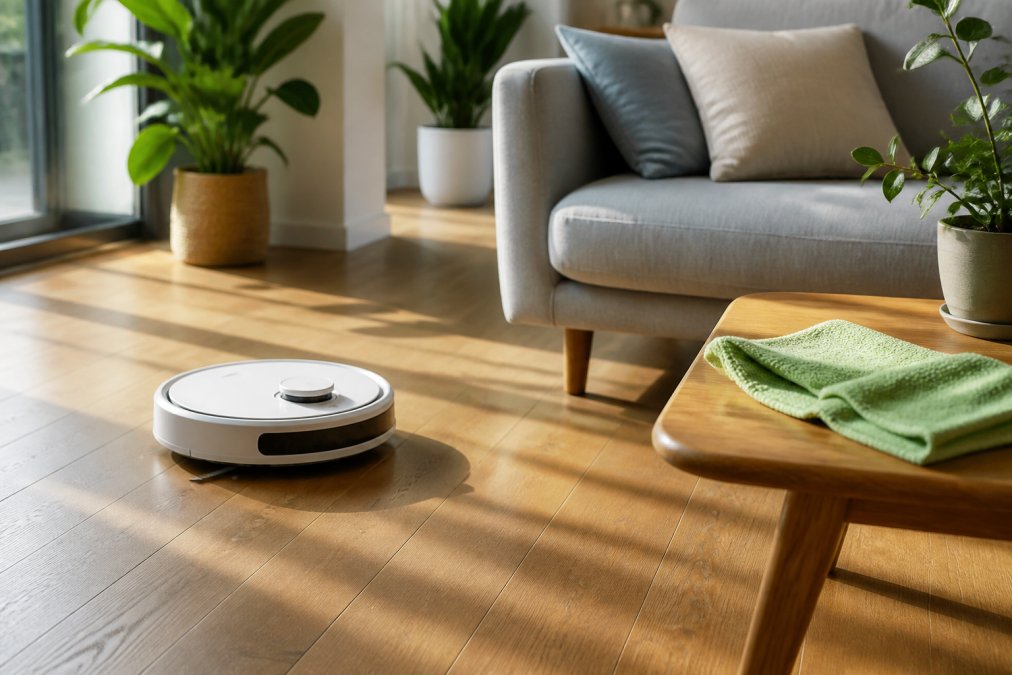
The Supersonic Smart Robot Vacuum Sweep Cleaner with Gyroscope Technology ($175.76) handles carpets and hardwood floors with a HEPA filter that traps fine particles instead of recirculating them. It runs up to 100 minutes per charge, returns to its charging base below 20% battery, and works with Amazon Alexa or a mobile app. Multiple modes cover zigzag, spot, manual, and edge cleaning.
Ultrasonic Cleaner for Small Items and Jewelry
The Ultrasonic Cleaner with Digital Timer and Heater ($121.15) cleans glasses, watches, rings, and small parts using water and vibration, no chemical solvents required. The 2L stainless steel tank includes a heater and timer, which means you skip the harsh jewelry cleaners and single-use polishing cloths entirely. It's greywater safe in the sense that no cleaning agents enter the drain at all.

Pet-Safe Cleaning Products for Homes with Animals
Pet-safe cleaning products avoid the ingredients most likely to irritate animals: synthetic fragrance, phthalates, and volatile organic compounds (VOCs). Look for synthetic fragrance-free, phthalate-free, and hypoallergenic formulas.
Refillable Cleaning Systems and Sustainable Packaging
Refillable cleaning systems replace single-use plastic bottles with concentrated formula refills, tablets, or refillable glass bottles. This directly addresses the 42% of household plastic packaging that ends up as waste, but the format you choose matters more than the refill label itself.
The Lifecycle Math: Shipping Water vs. Shipping Concentrate
This is the part most guides skip. A standard all-purpose spray is roughly 90% water. When you buy a pre-diluted bottle, you are paying to ship water, by truck, on pallets, in cases, and the carbon cost of that transport is baked into the product before it ever reaches your counter.
Supersonic Smart Robot Vacuum Sweep →
Disposal and Recycling Nuances
Not all "recyclable" packaging is actually recycled. The recycling rate for plastic containers varies widely by municipality, and mixed-material packaging, a pouch with a plastic spout, a bottle with a pump and a metal spring, a tube with a laminated liner, is the hardest to process and the most likely to end up in landfill even when it carries a recycling symbol.
A few practical rules:
- Pouches and refill sachets are usually not recyclable curbside. Check for a store drop-off program before buying in bulk.
- Pumps and spray triggers are mixed plastic and metal. Remove them before recycling the bottle; most curbside programs reject them attached.
- Glass bottles are widely recyclable and can be refilled many times, but check whether your local program accepts colored glass.
- Concentrate tablets in a wrapper often generate less total material than a refill pouch, even though the wrapper itself isn't recyclable.
- "Biodegradable" plastic is a separate claim from recyclable, and most curbside programs don't accept it. Don't assume it breaks down in a landfill, it usually doesn't.
What to Look For on the Shelf
- A refill format that ships as concentrate, tablet, or dry sheet, not a pre-diluted "refill" bottle.
- A bottle designed to be refilled, not just recycled.
- A take-back or store drop-off program for pouches and sachets.
- A clear statement of what the packaging is made of, so you can sort it correctly at the curb.
Get those four right and the refill system actually delivers the waste reduction it promises.
How to Switch to Green Cleaning Without Wasting Money
Switching to green cleaning without wasting money means replacing products as they run out, not all at once. Most people overspend by buying a full new cabinet of supplies on day one.
Here's a cost-conscious order of operations:
- Finish your current all-purpose cleaner before buying a replacement
- Switch the products you use most often first, like floor and surface cleaners
- Buy concentrate refills instead of pre-diluted bottles
- Add one durable tool, like a robot vacuum or microfiber mitts, to replace disposables
- Test one new product at a time so you know what actually works
Common Mistakes When Buying Eco-Friendly Cleaning Supplies
The biggest mistake is trusting the word "natural" on a label. It has no legal definition, and greenwashing is common enough that consumers now demand third-party proof.
Three more mistakes to avoid:
- Buying everything at once. You waste money on products you won't use for months.
- Ignoring the ingredient list. Paraben-free and phosphate-free claims mean nothing if you don't verify them.
- Assuming eco-friendly means weaker. A 2L ultrasonic cleaner or a HEPA robot vacuum often outperforms the disposable alternative.
Conclusion: Building a Greener Cleaning Routine
The challenge with going green isn't finding products. It's finding ones that actually work, last, and don't cost more than they should. Downtown5 stocks a curated range of home goods built around exactly that trade-off, from the Supersonic Smart Robot Vacuum with its HEPA filter and 100-minute runtime to the Ultrasonic Cleaner and reusable microfiber mitts. Seamless shipping and competitive pricing make it easy to start with one durable tool and build from there.
Frequently Asked Questions
What is the best eco-friendly cleaning brand?
There is no single best brand because the right choice depends on what you need to clean. Look for products with EPA Safer Choice certification, plant-derived surfactants, and refillable or plastic-free packaging. The eco-friendly cleaning product sector is growing at 9.15% annually, so more options arrive each year. Focus on certifications and ingredient lists rather than brand names alone.
How do I know if a cleaning product is truly eco-friendly?
Check for third-party certifications like the EPA's Safer Choice ecolabel, which experts identify as the gold standard for verifying non-toxic and sustainable claims. Avoid products with synthetic fragrances, phthalates, parabens, or volatile organic compounds (VOCs). Transparent ingredient lists and cruelty-free statements are also good signals. Be wary of vague terms like 'natural' without supporting documentation.
Are natural cleaning products as effective as traditional cleaners?
Yes, when formulated well. A 2022 NCBI study examined associations between green, homemade, and conventional cleaning products and asthma outcomes, supporting the case for gentler formulas. In 2026 testing, Simple Living Eco Multi-Purpose Cleaning Sheets scored 77/100 for plastic reduction and performance. Plant-derived surfactants and concentrated formulas now handle kitchen grease and soap scum effectively without harsh chemicals.
What are the best non-toxic cleaning products for home cleaning?
Prioritize multi-purpose cleaners with plant-based ingredients, phosphate-free formulas, and biodegradable agents. For floors, a robot vacuum with a HEPA filter like the Supersonic Smart Robot Vacuum ($175.76) traps dust and allergens. For small items, an ultrasonic cleaner ($121.15) uses water and vibration instead of solvents. Always verify EPA Safer Choice certification before buying.
How do I switch to green cleaning without wasting money?
Start by replacing one product at a time as it runs out, not all at once. Choose concentrated formulas that last longer, and invest in refillable cleaning systems to cut plastic waste. Household plastic packaging accounts for 42% of all plastic waste, so refillable options reduce both environmental impact and long-term cost. Compare DIY vs. store-bought costs for simple solutions like vinegar and baking soda.